
Having tried reviewing films, I'd like to try reviewing a novel - and a Man Booker Prize winning novel at that. For Christmas, a friend gave me a copy of "The Narrow Road to the Deep North", by the Australian writer, Richard Flanagan. It won the Man Booker Prize in 2014, impressing the judges greatly: "...this year a masterpiece has won it" (A. C. Grayling, Chair of judges). I was prepared to be sceptical after reading that, but I need not have been. The book is a fascinating account of an Australian doctor, Dorrigo Evans, who is captured after the fall of Singapore in 1942, and becomes a hero to the Australian public after the end of the war because of the care he gives to his patients and fellow prisoners on the infamous "Death Railway" in Burma, on which so many POWs laboured, suffered and died under a brutal Japanese prison regime. Flanagan's own father was a survivor of this protracted atrocity. Arifa Akbar commented in "The Independent":
"The anguish that Flanagan felt over the PoW experience, and the need for emotional catharsis, was not solely rooted in his father's trauma. (His father in a tragic twist of fate, died aged 98, on the day the novel was completed). Flanagan also drew on his own anguish: "I felt I carried something within me as a consequence of growing up as a child of the death railway. People come back from cosmic trauma but the wound does not end with them. It passes on to others."
Reading the sections of the book that deal with Dorrigo Evans' horrific experiences in Japanese captivity, I was struck by their vividness and capacity to shock, even after having spent decades reading of War and its attendant evils. This shows that Flanagan listened long and attentively to his father and other survivors of Japanese captivity. In fact, these sections of the book bear a strong resemblance to a book by another Australian author, Russell Braddon - "The Naked Island". Braddon, like Flanagan's father and Dorrigo Evans, was captured at Singapore and endured the same treatment from the Japanese. At times, I thought I was reading the same book. Susan Lever, in the "Sydney Review of Books" notes of Flanagan's book:
"Evans’s memories are triggered by the task of writing the foreword for a collection of sketches done by Guy ‘Rabbit’ Hendricks, one of the men who died in the camps."
I wonder if Flanagan had Braddon's book in mind when he invented this character, as the cartoonist Ronald Searle was a fellow-prisoner with Braddon on the Death Railway and, after liberation, published a book of sketches about "life" in Japanese captivity. Searle, unlike Hendricks, survived.
Dorrigo Evans conducts himself heroically in the camps, treating his patients with care, skill and pitifully inadequate resources, doing his best to provide comfort for the surviving and the dying (of whom there are plenty). No wonder post-war Australia treats him as a hero.
Evans, however, is not without his faults. Before going to war, he has a passionate affair with his uncle's wife, and hundreds more adulterous affairs after he becomes famous. Flanagan is moralising here, consciously or otherwise. At least, he is telling us that light and shade exist in all people, and that good men can serve bad causes and vice versa.
He further exemplifies this by his portrayal of his Japanese and Korean guard characters, and their fates after the war. Akbar again:
"Flanagan's book does not just trace Dorrigo's inner world, but gives his Japanese "torturers" and camp commanders a voice, and a subjectivity, that incorporates humanity and tenderness, rather than a black-and-white evil."
Flanagan also points towards the post-war readiness of Allied commanders to forgive and forget some hideous Japanese atrocities, which rival any Nazi atrocities for sheer horror - the vivisection of living American airmen without anaesthetic at Kyushu University. As Sato, one of these criminals, says in the book:
"...neither our government nor the Americans want to dig up the past. The Americans are interested in our biological warfare work; it helps them prepare for war against the Soviets".
Flanagan even visited the commander of his father's prison camp, describing him as a "gentle, gracious old man". His father too:
""He brought us up not to hate, never to judge. He had no hate [for the Japanese]. What my father took out of the camps was this extraordinary sense that everything is an illusion except for what you are like with other people, and to never think other people are in any way lesser than you."
I find that very noble, and admit that I could not be like that. Nor was this view common among other ex-prisoners of the Japanese after the war. Many, if not most, soldiers of all Allied armies belonging to the nations who fought the Japanese in the front lines felt an enduring, visceral hatred. In his book on the Battle of Kohima, "Road of Bones - The Siege of Kohima 1944", Feargal Keane tells of a British veteran who could not rid himself of his loathing for the Japanese until, years later, as an ordained clergyman, he baptised an Anglo-Japanese baby.
If I have a major criticism of the book, it is that it does seem to tend towards a type of moral relativism of the "We're all as bad as one another" or"There's good and bad in all kinds" type of cliché. This is especially prevalent in "revisionist" historians of World War Two, who like to point out Allied excesses as being "as bad as" those of the Axis powers - all of which is completely wrong. As Herbert Marcuse pointed out in another context: "There is a difference between Red Terror and White Terror". Further - there is a difference between the Allied aerial bombing of Germany and the Holocaust; between the sinking of convoys to Britain and the sinking of U-Boats; between the multitudinous atrocities of the Japanese and the atom bombs on Hiroshima and Nagasaki.
In fairness to Richard Flanagan, he has not stated the moral relativist case explicitly, but the implication seems to be there.
I realise that this is not a "normal" book review, but the fact remains that, as George Orwell, Mao Zedong and Leon Trotsky said : "All art is propaganda" - and every artist of every medium has a "message". For a more literary type of critique, I point the reader to a review by Michael Hoffman in the London Review of Books. Here is a flavour of it:
"The Narrow Road to the Deep North is the novel in an advanced and showy state of dissolution. It is as though the contemporary novel – like film (4-D, coming soon to a cinema near you), like theatre, like so much else – is in competition with itself, falling over itself to offer you more interiority, more action, more understanding, more vision. But the form, the vessel, is an exploded form; it is basically rubble, fragmentary junk, debris. It’s not even leaky anymore; it can hold nothing"
Happy reading for those who like this kind of thing! Personally, I think it should be sent to "Pseud's Corner" in "Private Eye".
No, "The Narrow Road to the Deep North" is an important and moving book, well worth reading, despite its flaws (or my criticisms).
Friday, 12 June 2015

Wednesday, 3 June 2015
Heysel 30 years on
 A few days ago, I heard a documentary on the BBC World Service commemorating the 30th anniversary of the Heysel Stadium disaster. It was something of a shock to realise how much time had elapsed since I'd watched that terrible event on television, but it also brought back some personal memories.
I'm not much interested in football, but my father was a lifelong fan of Liverpool FC. He'd go to every home match and away game that his job and circumstances permitted, and when his work took him abroad, as it did a lot, he'd listen to crackly commentaries on the short wave radio.
In 1985, he was seriously ill, but was still looking forward to watching the European Cup Final between Juventus and Liverpool. My mother and I decided to watch the match with him. The horrendous events began to unfold before our eyes: bodies being carried away on makeshift stretchers, a Juventus fan brandishing a pistol, crowds swirling and hostile fans facing each other, or fleeing from each other. Watching it on the TV, I found it impossible to work out who was to blame.
As the situation went from bad to worse, sports commentators found themselves having to report and comment on something way outside their field of expertise. They came out with all the insights and clichés you'd expect from an opinionated pub bore. Asked what they thought should be done, one replied that we should bring back corporal punishment, another said national service. Some felt more aggressive methods of crowd control should be brought in to deal with the 70s and 80s scourge of football hooliganism. All to a man condemned Liverpool fans out of hand. When a group of Juventus fans displayed a large banner stating "Liverpool animals", one said something to the effect that they were showing what they thought of the behaviour of the Liverpool fans. It occurred to none of them that you cannot conjure up such a banner out of nothing: it must have been prepared before the match with the aim of being provocative. None of them at the time ever mentioned the Juventus fan with the pistol whom I had clearly seen on the TV. So intent were they on blaming Liverpool fans that they ignored or failed to notice any fault in the opposing supporters. One even mourned the damage to the "beautiful Heysel stadium".
Then came the most extraordinary event of the whole night: UEFA ordered the teams to play the game. In a stadium from which they were still removing 39 dead bodies and tending to hundreds of the the injured, they had to play a game of football. I felt it was the most extreme example of getting your priorities wrong that I'd ever witnessed, and I still do. Although disgusted with the decision, I watched the match, willing Liverpool to win for my father's sake, but the final score was 1-0 to Juventus.
It was the last football match my father ever watched, and he died in the following month. I still regret that my father's lifelong support for Liverpool FC should end this way.
Aftermath: for several years, English football fans, Liverpool fans in particular, were pariahs in Europe. Then gradually, it was recognised that the Liverpool fans were not wholly to blame. The "beautiful" stadium turned out to decrepit, two police officers and the head of the Belgian FA were prosecuted as well as 26 Liverpool fans and gradually a slightly more balanced view of the disaster emerged. The selling of tickets in the Liverpool part of the stadium to Juventus fans had been the height of irresponsibility, but oddly enough, in their haste to condemn Liverpool fans, none of our sports commentators had thought it worth mentioning on the night.
Unfortunately, the view of football fans as drunken, out-of-control, feral hooligans led to increasingly oppressive methods of crowd control, and fans being caged in to keep rival supporters apart. And that directly takes us to the Hillsborough tragedy in 1989 where those very cages led to 96 more deaths. Because of the low opinion of football supporters, and so powerful were the voices of the politicians, the police, the football authorities and - the biggest culprit of all - the Sun that the official lies were accepted for years afterwards.
And what were moronic sports journalists saying? I clearly recall reading suggestions that Hillsborough was some kind of retribution for Heysel: I didn't think my opinion of sports commentators could sink any lower, but I was wrong.
I'm still not much interested in football, but I feel strongly about both of these disasters because of the terrible injustices imposed upon ordinary people. Yes, some Liverpool fans behaved disgracefully at Heysel, but many of the deaths were caused by the collapse of walls that were already crumbling. I've seen no evidence that any fan arrived in that stadium with murder in mind. The wholesale vilification of Liverpool fans after Heysel paved the way for the swallowing of the lies told about Hillsborough, which is how one disaster paved the way for the cover-ups and injustices of another. Only now, 26 years later, is the truth - of Hillsborough at least - finally coming out.
Saturday, 9 May 2015
A Reflection on the Election
As you might expect, I am not happy at the result of the General Election. I felt a sense of foreboding at Thursday's return of David Cameron and his merry men and women. They have already shown what they intend for the future of this country, and now have the means to do it - despite not having as large a majority as they would have liked. For the worst-off in Britain, a lot of pain is on the way.
But - more of that later. So much has been said and sung about the Election that it is difficult to find anything original to say, but I still think there are areas worthy of comment.
One blindingly obvious aspect to comment upon is the remarkable failure of the pollsters and the pundits to predict the Tory victory. Only a week ago, we were being assured of a minority government. Oh, dear... Nevertheless, they were proven to be only too accurate in their predictions for Scotland. It appears that the polling companies are deeply embarrassed at what happened, and are going to hold their own enquiry into why they got it so wrong. Peter Kellner, the YouGov president says that the public have been deceitful with their voting intentions. He has said that politicians "should campaign on what they believe, they should not listen to people like me and the figures we produce".
That makes very good sense. Too much sensitivity to opinion polls can lead to vacillation and abandonment of principle, if carried too far. Still, perhaps we should be glad that we are still capable, as an electorate and as people, of surprising our politicians. It shows that winning elections is not simply a matter of manipulating people, but a matter of winning them over by persuasion, argument and sincere conviction.
Another area of interest is the soul searching that is starting to happen in all the other parties except the Conservatives and the SNP. Labour, LibDems, Plaid Cymru, the Green Party and UKIP seem to be settling down to furious internal investigations and, as we all know, three party leaders have resigned. Well, Plaid Cymru, the Greens and UKIP need look no further than the electoral system itself; if we had PR, these parties would have more MPs. As for the LibDems, now reduced to a rump, the obvious answer to the question: "What went wrong?"was their coalition with the Tories. Their recent decimation was predicted five years ago after their notorious U-turn on tuition fees, but they did not listen. It shows the truth of the old saying: "He who sups with the devil should have a long spoon". In this case, no supping at all would have been the best course of action. It's easy to be right with hindsight, I suppose, but the Lib Dems now face a huge uphill task to restore their electoral fortunes. I hope they do, as some of their ousted MPs were fine workers for their constituencies - and I would never vote LibDem.
As for Labour, the explanations are already being floated. I agree with David Blunkett, who told the Guardian:
“If we have lost this election, we lost it from 2010 when in the six months from 2010 we failed to nail the lie that the Labour government had been responsible for the global meltdown and everything that happened in the US, France, Greece, Italy, Portugal, was the Labour government’s fault.”
He is right - Labour was far too passive in the face of such attacks, and should have refuted this accusation decisively.
But there was another type of attack which, in my opinion, Labour could have used, and the Conservatives certainly did, and that is what Social Europe calls "Negative Campaigning". One early, nasty, example of this happened back in 2013 when the Daily Mail tried smearing Ed Miliband's father by saying Ralph Miliband was a Marxist who hated Britain. This scurrilous article in the Mail, more appropriate to anti-Semitic Nazi newspapers of the 1930s than any British newspaper of any period, only just stopped short of accusing the whole Miliband family of being Jewish Communists.
A less nasty, but equally negative attack by the Tories was their poster campaign warning us of how, essentially, Labour was about to sell out England by going into coalition with the SNP.
Whatever the truth of this, and other accusations, they seem to have had considerable impact, perhaps even influencing some voters to change their voting preference.
I think that Labour should have reacted to the Tory campaign by focussing upon the depredations that Tory policies have already had upon the lives of ordinary people. The growth in the use of food banks, for example, as well as the rise in homelessness caused by the Bedroom tax and other factors, the use of unqualified teachers in schools, all could have provided material for a very effective "negative" campaign. The implication these things could get worse might have made a significant impact.
Lastly, Mr Cameron and his party might not be smirking for long. As "Spiked" has commented:
"Yet what does the Tory victory amount to? The party has increased its share of the vote since 2010 by just over half of one per cent – from an unspectacular 36.05 per cent to 36.7 per cent. Some polls had the Tories on that sort of mark during the campaign, while the ‘poll of polls’ tended to have them hovering around an average of 34 per cent. That extra couple of points hardly looks like any dramatic ‘late breakthrough’."
Besides this, Mr Cameron will almost certainly find the pressure of his restored role more intense than he seems to expect. He must reshuffle his cabinet, and all the issues mentioned above - the ones that Labour did not, with mistaken chivalry, exploit - not to mention a rampant SNP presence in Parliament,will start to crowd in upon him. In about a year or so, if the non-governing parties regroup, Messrs Miliband, Clegg, Balls and Farage might have something to smile about. The poor, of course, the people who go to food banks, who lose their homes because of the bedroom tax or because of rent increases, who work on zero hours contracts, will not be smiling at all. Like I said earlier, a lot of pain is on the way.
But - more of that later. So much has been said and sung about the Election that it is difficult to find anything original to say, but I still think there are areas worthy of comment.
One blindingly obvious aspect to comment upon is the remarkable failure of the pollsters and the pundits to predict the Tory victory. Only a week ago, we were being assured of a minority government. Oh, dear... Nevertheless, they were proven to be only too accurate in their predictions for Scotland. It appears that the polling companies are deeply embarrassed at what happened, and are going to hold their own enquiry into why they got it so wrong. Peter Kellner, the YouGov president says that the public have been deceitful with their voting intentions. He has said that politicians "should campaign on what they believe, they should not listen to people like me and the figures we produce".
That makes very good sense. Too much sensitivity to opinion polls can lead to vacillation and abandonment of principle, if carried too far. Still, perhaps we should be glad that we are still capable, as an electorate and as people, of surprising our politicians. It shows that winning elections is not simply a matter of manipulating people, but a matter of winning them over by persuasion, argument and sincere conviction.
Another area of interest is the soul searching that is starting to happen in all the other parties except the Conservatives and the SNP. Labour, LibDems, Plaid Cymru, the Green Party and UKIP seem to be settling down to furious internal investigations and, as we all know, three party leaders have resigned. Well, Plaid Cymru, the Greens and UKIP need look no further than the electoral system itself; if we had PR, these parties would have more MPs. As for the LibDems, now reduced to a rump, the obvious answer to the question: "What went wrong?"was their coalition with the Tories. Their recent decimation was predicted five years ago after their notorious U-turn on tuition fees, but they did not listen. It shows the truth of the old saying: "He who sups with the devil should have a long spoon". In this case, no supping at all would have been the best course of action. It's easy to be right with hindsight, I suppose, but the Lib Dems now face a huge uphill task to restore their electoral fortunes. I hope they do, as some of their ousted MPs were fine workers for their constituencies - and I would never vote LibDem.
As for Labour, the explanations are already being floated. I agree with David Blunkett, who told the Guardian:
“If we have lost this election, we lost it from 2010 when in the six months from 2010 we failed to nail the lie that the Labour government had been responsible for the global meltdown and everything that happened in the US, France, Greece, Italy, Portugal, was the Labour government’s fault.”
He is right - Labour was far too passive in the face of such attacks, and should have refuted this accusation decisively.
But there was another type of attack which, in my opinion, Labour could have used, and the Conservatives certainly did, and that is what Social Europe calls "Negative Campaigning". One early, nasty, example of this happened back in 2013 when the Daily Mail tried smearing Ed Miliband's father by saying Ralph Miliband was a Marxist who hated Britain. This scurrilous article in the Mail, more appropriate to anti-Semitic Nazi newspapers of the 1930s than any British newspaper of any period, only just stopped short of accusing the whole Miliband family of being Jewish Communists.
A less nasty, but equally negative attack by the Tories was their poster campaign warning us of how, essentially, Labour was about to sell out England by going into coalition with the SNP.
Whatever the truth of this, and other accusations, they seem to have had considerable impact, perhaps even influencing some voters to change their voting preference.
I think that Labour should have reacted to the Tory campaign by focussing upon the depredations that Tory policies have already had upon the lives of ordinary people. The growth in the use of food banks, for example, as well as the rise in homelessness caused by the Bedroom tax and other factors, the use of unqualified teachers in schools, all could have provided material for a very effective "negative" campaign. The implication these things could get worse might have made a significant impact.
Lastly, Mr Cameron and his party might not be smirking for long. As "Spiked" has commented:
"Yet what does the Tory victory amount to? The party has increased its share of the vote since 2010 by just over half of one per cent – from an unspectacular 36.05 per cent to 36.7 per cent. Some polls had the Tories on that sort of mark during the campaign, while the ‘poll of polls’ tended to have them hovering around an average of 34 per cent. That extra couple of points hardly looks like any dramatic ‘late breakthrough’."
Besides this, Mr Cameron will almost certainly find the pressure of his restored role more intense than he seems to expect. He must reshuffle his cabinet, and all the issues mentioned above - the ones that Labour did not, with mistaken chivalry, exploit - not to mention a rampant SNP presence in Parliament,will start to crowd in upon him. In about a year or so, if the non-governing parties regroup, Messrs Miliband, Clegg, Balls and Farage might have something to smile about. The poor, of course, the people who go to food banks, who lose their homes because of the bedroom tax or because of rent increases, who work on zero hours contracts, will not be smiling at all. Like I said earlier, a lot of pain is on the way.
Thursday, 16 April 2015
Life Imitates Art - President Putin and the Threepenny Opera
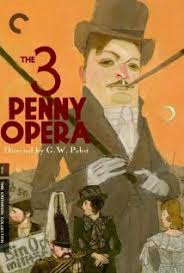
Most people will have heard the opening song to "The Threepenny Opera" by Kurt Weill and Bertolt Brecht - even if you've never seen the play, you will have heard "Mack the Knife" at some time. Originally written and composed in the 1920s, it has proven to be an enduring classic, recorded by a wide range of singers such as Bobby Darin, Ella Fitzgerald, Lotte Lenya (Kurt Weill's wife), Frank Sinatra, Louis Armstrong and even modern singers such as Ute Lemper, Michael Buble, and Robbie Williams. There is also an excellent Country and Western version by Jimmie Dale Gilmore. The song is so highly regarded that it has been included in The Great American Songbook. This is a remarkable achievement, made even more remarkable when we examine the politics of the writers involved and the content of the lyrics.
Bertolt Brecht, the librettist, was what is now known as a "Tankie Marxist", who fled Germany just before the Nazi takeover in 1933. He took refuge in the USA during WW2, later being questioned by the House Un-American Activities Committee, where he denied being a Communist (to the disgust of many who knew him), eventually moving to East Germany, where he died, an apparent supporter of the regime. This is not the biography that might be expected of someone whose work appears in the Great American Songbook. His composer associate, Kurt Weill, who also escaped to America, split from Brecht in the 1940s, because, as his widow Lotte Lenya said, he could not "..."set the Communist Manifesto (by Marx and Engels) to music." Nevertheless, without Weill's jaunty tune, "Mack the Knife" would probably not have been the success that it has become.
The other remarkable aspect of the song's popularity is the content of the lyrics. Now, the song we know is translated from German, the best known being that by Mark Blitzstein, which was the Bobby Darin version, but there are other translations. Translations or not, the lyrics provide a chilling picture of crimes committed by the play's anti-hero, Captain Macheath ("Mack"). As a writer of lyrics myself, I am sometimes questioned about the serious nature of some of my subject matter. Even I, however (and I admire Brecht), would never touch on these events, found in "Mack the Knife":
1. Mack goes about "tooled up" with a jack-knife, and always ready to use it.
2. A man is murdered on a pleasant Sunday morning (Mack is suspected)
3.A grandfather and seven grandchildren die in an arson attack in Soho (Mack is suspected)
4. A corpse, presumably the victim of a hit, is dumped in the Thames (Again, Mack is suspected).
5. Wealthy Louie Miller is found dead and Mack suddenly "...spends like a sailor".
Well, I certainly would never include any such crimes in one of my lyrics -I write about them here, on my blog. It is a tribute to the artistry of Weill and Brecht that the song works so well.
If you read the playscript, or watch the play itself, you will see at once that Macheath is not a "real" person. Produced in 1928, it is one of Brecht's earliest plays to use the technique of "alienation", where the characters represent attitudes or abstractions. Anyone who has seen agitprop alternative theatre companies will be familiar with the technique. There are many interpretations of what Macheath symbolises, but what interests me is the fact that, in the first part of the play at least, Mack manages to avoid being directly incriminated for his criminal activities; there is no "smoking gun" (or bloody knife) that leads to his conviction. Mack is a "slippery customer" who, like many leading gangland figures, has friends in the police. Mack's "bent copper" is Tiger Brown who, in the play, assures Mack in Act One, Scene Two, that:
"There's nothing whatsoever on record against you at Scotland Yard".
This aspect of Macheath's character has sinister parallels with some historic and present day political figures. Lotte Lenya, for instance, saw a resemblance of Mack to Hitler during the build-up to the Nazi leader's seizure of power in Germany. No matter what crimes were attributed to the Nazi thugs of the SS and SA, nothing could be proved against Hitler. Even when planning, and executing, the Final Solution, Hitler saw the need to try and avoid written records of his heinous crimes. Mack would have been proud of him.
Mack's influence can also be seen today in the alleged outrages of President Vladimir Putin. It is said by some that President Putin has been behind the murders of numerous people who have been unwise enough to upset him Here are just a few (alleged) examples:
November, 1998, Less than four months after Putin takes over at the KGB, opposition Duma Deputy Galina Starovoitova, the most prominent pro-democracy Kremlin critic in the nation, was murdered at her apartment building in St. Petersburg.
April, 2003. Sergei Yushenkov, co-chairman of the Liberal Russia political party, was gunned down at the entrance of his Moscow apartment block. Yushenkov was vice chairman of the“Kovalev Commission” which was formed to informally investigate charges that Putin’s KGB had planted the Pechatniki and Kashirskoye apartment bombs (September, 1999) to whip up support for Putin’s war in Chechnya after the formal legislative investigation turned out to be impossible. Another member of the Commission, Yuri Shchekochikhin, died of poisoning, a third was severely beaten by thugs, and two other members lost their seats in the Duma.
September, 2006. Andrei Kozlov, First Deputy Chairman of Russia’s Central Bank, who strove to stamp out money laundering, the highest-ranking reformer in Russia, was assassinated in Moscow.
October, 2006. Anna Politkovskaya, author of countless books and articles exposing Russian human rights violations in Chechnya and attacking Vladimir Putin as a dictator, was murdered at her home in Moscow.
November, 2006. Alexander Litvinenko, KGB defector and author of the book Blowing up Russia, which accuses the Kremlin of masterminding the Pechatniki and Kashirskoye bombings in Moscow in order to blame Chechen terrorists and whip up support for an invasion of Chechnya (which shortly followed), was fatally poisoned by radioactive Polonium obtained from Russian sources. This killing, which took place in London, is currently under investigation here in Britain.
Now, as can clearly be seen, all these people - and these are just a sample of many victims worthy of mention - were not exactly friendly to President Putin. Many more of his critics (mostly journalists) have died in suspicious circumstances, and yet there is no conclusive evidence to prove Putin's involvement. Those of you who read this blog's Christmas Message last December will recall that he vehemently denies any involvement in the murder of people he dislikes. And, despite the best efforts of his foes in Russia and beyond, no-one has "the goods" on him. Like Macheath, there is nothing on record against him at Scotland Yard, or anywhere else.
The former world chess champion, Gary Kasparov, has said that to understand Putin's Russia, we should dispense with reading Karl Marx and read the books of Mario Puzo instead. Mario Puzo, we may recall, is the author of "The Godfather" books. Whatever books we read, it looks like Macheath is back in town.
Bertolt Brecht, the librettist, was what is now known as a "Tankie Marxist", who fled Germany just before the Nazi takeover in 1933. He took refuge in the USA during WW2, later being questioned by the House Un-American Activities Committee, where he denied being a Communist (to the disgust of many who knew him), eventually moving to East Germany, where he died, an apparent supporter of the regime. This is not the biography that might be expected of someone whose work appears in the Great American Songbook. His composer associate, Kurt Weill, who also escaped to America, split from Brecht in the 1940s, because, as his widow Lotte Lenya said, he could not "..."set the Communist Manifesto (by Marx and Engels) to music." Nevertheless, without Weill's jaunty tune, "Mack the Knife" would probably not have been the success that it has become.
The other remarkable aspect of the song's popularity is the content of the lyrics. Now, the song we know is translated from German, the best known being that by Mark Blitzstein, which was the Bobby Darin version, but there are other translations. Translations or not, the lyrics provide a chilling picture of crimes committed by the play's anti-hero, Captain Macheath ("Mack"). As a writer of lyrics myself, I am sometimes questioned about the serious nature of some of my subject matter. Even I, however (and I admire Brecht), would never touch on these events, found in "Mack the Knife":
1. Mack goes about "tooled up" with a jack-knife, and always ready to use it.
2. A man is murdered on a pleasant Sunday morning (Mack is suspected)
3.A grandfather and seven grandchildren die in an arson attack in Soho (Mack is suspected)
4. A corpse, presumably the victim of a hit, is dumped in the Thames (Again, Mack is suspected).
5. Wealthy Louie Miller is found dead and Mack suddenly "...spends like a sailor".
Well, I certainly would never include any such crimes in one of my lyrics -I write about them here, on my blog. It is a tribute to the artistry of Weill and Brecht that the song works so well.
If you read the playscript, or watch the play itself, you will see at once that Macheath is not a "real" person. Produced in 1928, it is one of Brecht's earliest plays to use the technique of "alienation", where the characters represent attitudes or abstractions. Anyone who has seen agitprop alternative theatre companies will be familiar with the technique. There are many interpretations of what Macheath symbolises, but what interests me is the fact that, in the first part of the play at least, Mack manages to avoid being directly incriminated for his criminal activities; there is no "smoking gun" (or bloody knife) that leads to his conviction. Mack is a "slippery customer" who, like many leading gangland figures, has friends in the police. Mack's "bent copper" is Tiger Brown who, in the play, assures Mack in Act One, Scene Two, that:
"There's nothing whatsoever on record against you at Scotland Yard".
This aspect of Macheath's character has sinister parallels with some historic and present day political figures. Lotte Lenya, for instance, saw a resemblance of Mack to Hitler during the build-up to the Nazi leader's seizure of power in Germany. No matter what crimes were attributed to the Nazi thugs of the SS and SA, nothing could be proved against Hitler. Even when planning, and executing, the Final Solution, Hitler saw the need to try and avoid written records of his heinous crimes. Mack would have been proud of him.
Mack's influence can also be seen today in the alleged outrages of President Vladimir Putin. It is said by some that President Putin has been behind the murders of numerous people who have been unwise enough to upset him Here are just a few (alleged) examples:
November, 1998, Less than four months after Putin takes over at the KGB, opposition Duma Deputy Galina Starovoitova, the most prominent pro-democracy Kremlin critic in the nation, was murdered at her apartment building in St. Petersburg.
April, 2003. Sergei Yushenkov, co-chairman of the Liberal Russia political party, was gunned down at the entrance of his Moscow apartment block. Yushenkov was vice chairman of the“Kovalev Commission” which was formed to informally investigate charges that Putin’s KGB had planted the Pechatniki and Kashirskoye apartment bombs (September, 1999) to whip up support for Putin’s war in Chechnya after the formal legislative investigation turned out to be impossible. Another member of the Commission, Yuri Shchekochikhin, died of poisoning, a third was severely beaten by thugs, and two other members lost their seats in the Duma.
September, 2006. Andrei Kozlov, First Deputy Chairman of Russia’s Central Bank, who strove to stamp out money laundering, the highest-ranking reformer in Russia, was assassinated in Moscow.
October, 2006. Anna Politkovskaya, author of countless books and articles exposing Russian human rights violations in Chechnya and attacking Vladimir Putin as a dictator, was murdered at her home in Moscow.
November, 2006. Alexander Litvinenko, KGB defector and author of the book Blowing up Russia, which accuses the Kremlin of masterminding the Pechatniki and Kashirskoye bombings in Moscow in order to blame Chechen terrorists and whip up support for an invasion of Chechnya (which shortly followed), was fatally poisoned by radioactive Polonium obtained from Russian sources. This killing, which took place in London, is currently under investigation here in Britain.
Now, as can clearly be seen, all these people - and these are just a sample of many victims worthy of mention - were not exactly friendly to President Putin. Many more of his critics (mostly journalists) have died in suspicious circumstances, and yet there is no conclusive evidence to prove Putin's involvement. Those of you who read this blog's Christmas Message last December will recall that he vehemently denies any involvement in the murder of people he dislikes. And, despite the best efforts of his foes in Russia and beyond, no-one has "the goods" on him. Like Macheath, there is nothing on record against him at Scotland Yard, or anywhere else.
The former world chess champion, Gary Kasparov, has said that to understand Putin's Russia, we should dispense with reading Karl Marx and read the books of Mario Puzo instead. Mario Puzo, we may recall, is the author of "The Godfather" books. Whatever books we read, it looks like Macheath is back in town.
Friday, 27 March 2015
IS and the Attraction of Evil - Baffled by Brutality?
It is now clear that the horrific Germanwings air crash was caused by the mentally ill co-pilot, not by terrorists, as some had at first suspected. In no sense can this be considered a "relief", but, given the recent catalogue of horrors perpetrated by Islamic State (ISIS) and its friends, it is something approaching a welcome change. I sometimes wonder if ISIS are watching our response to their vile atrocities - it would be surprising if they weren't. If so, what are their strategic goals? Before trying to answer that question, it's worth reminding ourselves of the ugly nature of ISIS. They have:
1. Massacred Iraqi prisoners, Yazidis, Shia Muslims and Christians.
2. Women from minorities they hate have been enslaved and sexually abused.
3. They have introduced slavery into their areas of control.
4. Homosexuals are executed by being thrown from high buildings.
5. British and American hostages (and many others) have been beheaded - on film.
6. A Jordanian pilot was burned to death by ISIS after crashing in ISIS-controlled territory.
7. Their sympathisers, which include the murderous Boko Haram in Nigeria, have attacked targets as far apart as a synagogue in Belgium and a museum in Tunisia.
I could go on, but it would be more of the same. Listing these crimes is very bland, so it's worth remembering the terror and the horror experienced by the victims of ISIS. Last October, the Guardian ran a story about refugees who had fled ISIS to the comparative safety of Kobani, near the Turkish border. This was the story of just one such refugee:
"Kader fled 10 days ago, leaving his village, which lies 16km from Kobani centre, in the small hours of the morning. He and his wife took their five-year-old, their toddler and what little else they could carry.
His uncle planned to join them but at the last minute changed his mind, unable to leave a village that had been his home for more than eight decades. The militants beheaded him, refugees arriving later told Kader.
"He was 85 – he could not even lift a weapon," said the young father, baffled by the brutality. Even more haunting were stories from his wife's village, where the fleeing family found the bodies of her sister and an eight-year-old niece lying in pools of blood."
I am sure that the vast majority of people, learning of these appalling events and also baffled by the brutality, will have asked themselves the inevitable question: "How can anyone do such things?". Now, we ask this question a lot, usually after learning of the senseless murder of an innocent individual. This is a key question here, and I would like to attempt an answer, despite not being a criminologist. Alexander Solzhenitsyn once said:
"Men can only commit great acts of evil when they believe they are doing good".
I do not believe this applies to every member of ISIS, but it certainly appears to apply to similar ideological criminals of the past. For instance, Einsatzgruppen commanders, who led heinous atrocities against Jews and others in Poland, the Baltic States and German occupied Russia during WW2, saw themselves as waging a racial war for the glory of greater Germany. Even when brought to trial and sentenced to death, they expressed no remorse - because they believed they had done the right thing. The conduct of Stalin's torturers and jailers can also be explained to some degree in this way; they believed they were building a socialist state by eliminating or enslaving ideological deviants. Being convinced of the rectitude of your cause, sadly, seems to be able to override your deepest moral reservations - assuming, of course,that you had such reservations in the first place.
But does it end there? I don't think so. Some people like to blame religion - in this case Islam - for the problem with ISIS, and for war in general. This is a facile point, and invalid. It fails to allow for the fact that religious issues frequently combine, or run concurrently, with political issues. It also fails to recognise that violence and war exist in the human condition anyway, and exists where there is no religious dimension.
Another, admittedly broad, explanation for mass murder, is one that is suggested by the execution videos that ISIS make ( which Hitler's and Stalin's thugs never made). Anyone watching the hideous "Jihadi John" beheadings will have been struck by one thing: Mohammed Emwazi, (Jihadi John) was enjoying what he did. From other ISIS videos I have seen, this is the attitude of most ISIS members. To be fair, many become sickened by such actions. ISIS executes such "deviants" if they speak out, or get caught trying to escape. But it seems an inescapable fact that committing atrocities is as readily acceptable to ISIS as it was to Hitler or Stalin. When your humanitarian compass is replaced by an ideology that legitimises evil acts, there is no crime you are unable to commit, especially if you believe you are doing the will of Allah.
Yet this is nothing new. We all remember the inter-ethnic strife that erupted after the break-up of the state of Yugoslavia in the 1990s. What is forgotten is the fact that atrocities in the Balkans and Middle East were happening before WW1. At that time, the Edwardian Tory satirist, "Saki" (H.H.Munro), wrote:
“In the same way, whenever a massacre of Armenians is reported from Asia Minor, every one assumes that it has been carried out "under orders" from somewhere or another, no one seems to think that there are people who might LIKE to kill their neighbours now and then.”
The "I was only obeying orders" excuse should not be allowed for ISIS volunteers, any more than it should for the Nazis and Stalin's merry men. The known facts, together with reports of ISIS crimes against humanity preclude such a cop-out.
This leads to my final point. We all remember the fuss over the flight to Syria via Turkey by three East End schoolgirls.These girls, like many others, are pitied by many as victims of "grooming" by Jihadi militants. But do they deserve to be regarded as "victims"? And at what age do they lose their victimhood? The fact is, those three girls, and others, were fully aware of the nature of the ISIS state and the atrocities committed - so are they innocent dupes, or simply attracted by evil? No-one talks about this much, but it is certainly true that some individuals - many highly intelligent - seem to feel a fascination for evildoers.The Yorkshire Ripper, Peter Sutcliffe, for example, regularly received what can only be described as fan letters, mostly from women. Neo-Nazis, religious cults such as the Moonies, outlaw cults such as the Hell's Angels, and now ISIS, all attract admirers who blithely ignore the darker side of these organisations.
Finally, let's return to the question I raised first of all - what is the strategy of ISIS that drives their foul brutality? Well, as Lenin reportedly said, the object of terror is to terrify. This worked for ISIS with their initial military successes, when whole Iraqi Army units fled before them, and ISIS indulged their blood lust, confident their enemies would continue to be routed and run. A similar situation happened after the October Revolution when the Bolshevik Army invaded Poland in 1920. The Bolshevik advance was initially successful, like that of ISIS. Again like ISIS, the Bolshevik onslaught brought comparable atrocities against Polish prisoners. However, these atrocities did not daunt the Poles, who fought back all the harder, and were victorious. I have no doubt that ISIS atrocities will produce a similar effect. In the case of the Kurds, this has already happened. Perhaps, one day in the future, we will be debating how we should treat returning, defeated, ISIS volunteers.
1. Massacred Iraqi prisoners, Yazidis, Shia Muslims and Christians.
2. Women from minorities they hate have been enslaved and sexually abused.
3. They have introduced slavery into their areas of control.
4. Homosexuals are executed by being thrown from high buildings.
5. British and American hostages (and many others) have been beheaded - on film.
6. A Jordanian pilot was burned to death by ISIS after crashing in ISIS-controlled territory.
7. Their sympathisers, which include the murderous Boko Haram in Nigeria, have attacked targets as far apart as a synagogue in Belgium and a museum in Tunisia.
I could go on, but it would be more of the same. Listing these crimes is very bland, so it's worth remembering the terror and the horror experienced by the victims of ISIS. Last October, the Guardian ran a story about refugees who had fled ISIS to the comparative safety of Kobani, near the Turkish border. This was the story of just one such refugee:
"Kader fled 10 days ago, leaving his village, which lies 16km from Kobani centre, in the small hours of the morning. He and his wife took their five-year-old, their toddler and what little else they could carry.
His uncle planned to join them but at the last minute changed his mind, unable to leave a village that had been his home for more than eight decades. The militants beheaded him, refugees arriving later told Kader.
"He was 85 – he could not even lift a weapon," said the young father, baffled by the brutality. Even more haunting were stories from his wife's village, where the fleeing family found the bodies of her sister and an eight-year-old niece lying in pools of blood."
I am sure that the vast majority of people, learning of these appalling events and also baffled by the brutality, will have asked themselves the inevitable question: "How can anyone do such things?". Now, we ask this question a lot, usually after learning of the senseless murder of an innocent individual. This is a key question here, and I would like to attempt an answer, despite not being a criminologist. Alexander Solzhenitsyn once said:
"Men can only commit great acts of evil when they believe they are doing good".
I do not believe this applies to every member of ISIS, but it certainly appears to apply to similar ideological criminals of the past. For instance, Einsatzgruppen commanders, who led heinous atrocities against Jews and others in Poland, the Baltic States and German occupied Russia during WW2, saw themselves as waging a racial war for the glory of greater Germany. Even when brought to trial and sentenced to death, they expressed no remorse - because they believed they had done the right thing. The conduct of Stalin's torturers and jailers can also be explained to some degree in this way; they believed they were building a socialist state by eliminating or enslaving ideological deviants. Being convinced of the rectitude of your cause, sadly, seems to be able to override your deepest moral reservations - assuming, of course,that you had such reservations in the first place.
But does it end there? I don't think so. Some people like to blame religion - in this case Islam - for the problem with ISIS, and for war in general. This is a facile point, and invalid. It fails to allow for the fact that religious issues frequently combine, or run concurrently, with political issues. It also fails to recognise that violence and war exist in the human condition anyway, and exists where there is no religious dimension.
Another, admittedly broad, explanation for mass murder, is one that is suggested by the execution videos that ISIS make ( which Hitler's and Stalin's thugs never made). Anyone watching the hideous "Jihadi John" beheadings will have been struck by one thing: Mohammed Emwazi, (Jihadi John) was enjoying what he did. From other ISIS videos I have seen, this is the attitude of most ISIS members. To be fair, many become sickened by such actions. ISIS executes such "deviants" if they speak out, or get caught trying to escape. But it seems an inescapable fact that committing atrocities is as readily acceptable to ISIS as it was to Hitler or Stalin. When your humanitarian compass is replaced by an ideology that legitimises evil acts, there is no crime you are unable to commit, especially if you believe you are doing the will of Allah.
Yet this is nothing new. We all remember the inter-ethnic strife that erupted after the break-up of the state of Yugoslavia in the 1990s. What is forgotten is the fact that atrocities in the Balkans and Middle East were happening before WW1. At that time, the Edwardian Tory satirist, "Saki" (H.H.Munro), wrote:
“In the same way, whenever a massacre of Armenians is reported from Asia Minor, every one assumes that it has been carried out "under orders" from somewhere or another, no one seems to think that there are people who might LIKE to kill their neighbours now and then.”
The "I was only obeying orders" excuse should not be allowed for ISIS volunteers, any more than it should for the Nazis and Stalin's merry men. The known facts, together with reports of ISIS crimes against humanity preclude such a cop-out.
This leads to my final point. We all remember the fuss over the flight to Syria via Turkey by three East End schoolgirls.These girls, like many others, are pitied by many as victims of "grooming" by Jihadi militants. But do they deserve to be regarded as "victims"? And at what age do they lose their victimhood? The fact is, those three girls, and others, were fully aware of the nature of the ISIS state and the atrocities committed - so are they innocent dupes, or simply attracted by evil? No-one talks about this much, but it is certainly true that some individuals - many highly intelligent - seem to feel a fascination for evildoers.The Yorkshire Ripper, Peter Sutcliffe, for example, regularly received what can only be described as fan letters, mostly from women. Neo-Nazis, religious cults such as the Moonies, outlaw cults such as the Hell's Angels, and now ISIS, all attract admirers who blithely ignore the darker side of these organisations.
Finally, let's return to the question I raised first of all - what is the strategy of ISIS that drives their foul brutality? Well, as Lenin reportedly said, the object of terror is to terrify. This worked for ISIS with their initial military successes, when whole Iraqi Army units fled before them, and ISIS indulged their blood lust, confident their enemies would continue to be routed and run. A similar situation happened after the October Revolution when the Bolshevik Army invaded Poland in 1920. The Bolshevik advance was initially successful, like that of ISIS. Again like ISIS, the Bolshevik onslaught brought comparable atrocities against Polish prisoners. However, these atrocities did not daunt the Poles, who fought back all the harder, and were victorious. I have no doubt that ISIS atrocities will produce a similar effect. In the case of the Kurds, this has already happened. Perhaps, one day in the future, we will be debating how we should treat returning, defeated, ISIS volunteers.
Tuesday, 17 February 2015
Murder in Croydon - a Very Local Death
In April, 2014, a 52 year old man, Andrew Else, was stabbed to death on a Croydon street by a paranoid schizophrenic, 24 year old Ephraim Norman. Two weeks before, Norman had stabbed a 15 year old boy in the neck. At Norman's trial:
"Prosecutor Alan Kent QC said the teenager was "lucky" to survive after the blade was completely buried in his head with the tip poking out the other side."
Two weeks later, Norman followed Mr Else off a bus, then attacked him, stabbing Mr Else 200 times. Norman, who has been confined indefinitely to hospital treatment (hopefully), said that he felt no remorse for his deeds, or sympathy for Mr Else's family, because voices in his head were urging him on to kill:
"He told officers: "It is just my madness, it is just like how my mind is.... I know I could do that again. It is not a big thing for me to do ... I wanted him to die so much I just kept on stabbing him until he was dead".
Like other offenders of this type, it seems that Norman had stopped taking medication for his condition:
"The court was told that Norman attacked the teenager and Mr Else after he stopped taking his medication and claimed it made him impotent."
The judge who sentenced Norman said that Andrew Else was in the wrong place at the wrong time. As far as I can discover, no-one is being held to account for letting such an obviously dangerous man like Norman out on the streets in the first place.
I happened upon this story by accident. It is on the BBC London news section of their website, but has been given no great prominence. I find this alarming, not only because of the horrific nature of this killing, but because of the serious implications of failure in our mental health system. It raises the same questions that occurred to me when I wrote, in 2013, about the Nicola Edgington murder. Put simply, the questions are: How many murders are committed by released mental health patients? Why is it happening? Who is responsible?
For answers, I turn to the "Hundred Families" website, so called because, as it says on its Home Page:
"Around a 100 families a year will have a loved one killed by someone with mental illness."
The evidence for this is overwhelming; the website lists all known killings by mental health patients going back into the 1990s. In London alone, there were 272 known cases between 1993 and 2014; in the North West of England, during that period, there were 129 known cases. It is important to stress "known cases", as, in many murder and assault cases, the mental health problems of the perpetrators are not mentioned.
Julian Hendy, who runs the website, and whose own father was murdered in the street by a man with mental health problems, argues that this is happening because:
Many Mental Health Services are in denial about violence
They are failing to investigate properly
They are failing to learn lessons
They have a culture of secrecy
They treat symptoms not causes
Psychotic patients often don’t think they’re ill
This explains why these murders keep happening, in my opinion. It is also the opinion of many relatives of the victims. Jennifer Mills-Westley, a 60 year old woman, was decapitated by a Bulgarian, Deyan Deyanov, in 2011. Although the murder happened in Spain, Deyanov had been sectioned under the Mental Health Act and admitted to Glan Clwyd Hospital’s Ablett Psychiatric Unit in North Wales in the summer of 2010. Leaving the unit, he moved to Tenerife, where his schizophrenia deteriorated, leading to murder. Mrs Mills-Westley's family sought the truth and , in a statement, laid the blame at the door of the mental health managers who released Deyanov. Here is an extract from their statement:
"Three and a half years after the brutal murder of our mother we now know the truth leading up to that tragic events on Friday 13th May 2011.
The Health Inspectorate of Wales report has highlighted a number of significant basic medical best practice failures. These failings are far worse than we had imagined.
We are shocked to learn that the clearly prejudicial views of the medical staff severely compromised the diagnosis and therefore subsequent treatment of Deyan Deyanov.
Had Betsi Cadwaladr recognised that Deyan Deyanov was a young man with very serious mental health problems then our mother would still be alive today."
Now, it can be argued that mental health diagnosis is very difficult, and it is not always possible to judge the future actions of such patients upon release. This may be true, but the fact remains that there are far too many of these murders. So far, released mental health patients have killed more British citizens in the past 20 years than have Jihadi terrorists and the IRA.
To conclude, I would like to express my sympathy to the relatives of all such murder victims as described here. In particular, I send my condolences to the family of Andrew Else, whose horrific death was not thought of sufficient interest to be included on the national news. How sad it is, that the murder of a victim of some faceless person's decision to set at liberty a murderous schizophrenic should be thought of as being purely of local interest.
"Prosecutor Alan Kent QC said the teenager was "lucky" to survive after the blade was completely buried in his head with the tip poking out the other side."
Two weeks later, Norman followed Mr Else off a bus, then attacked him, stabbing Mr Else 200 times. Norman, who has been confined indefinitely to hospital treatment (hopefully), said that he felt no remorse for his deeds, or sympathy for Mr Else's family, because voices in his head were urging him on to kill:
"He told officers: "It is just my madness, it is just like how my mind is.... I know I could do that again. It is not a big thing for me to do ... I wanted him to die so much I just kept on stabbing him until he was dead".
Like other offenders of this type, it seems that Norman had stopped taking medication for his condition:
"The court was told that Norman attacked the teenager and Mr Else after he stopped taking his medication and claimed it made him impotent."
The judge who sentenced Norman said that Andrew Else was in the wrong place at the wrong time. As far as I can discover, no-one is being held to account for letting such an obviously dangerous man like Norman out on the streets in the first place.
I happened upon this story by accident. It is on the BBC London news section of their website, but has been given no great prominence. I find this alarming, not only because of the horrific nature of this killing, but because of the serious implications of failure in our mental health system. It raises the same questions that occurred to me when I wrote, in 2013, about the Nicola Edgington murder. Put simply, the questions are: How many murders are committed by released mental health patients? Why is it happening? Who is responsible?
For answers, I turn to the "Hundred Families" website, so called because, as it says on its Home Page:
"Around a 100 families a year will have a loved one killed by someone with mental illness."
The evidence for this is overwhelming; the website lists all known killings by mental health patients going back into the 1990s. In London alone, there were 272 known cases between 1993 and 2014; in the North West of England, during that period, there were 129 known cases. It is important to stress "known cases", as, in many murder and assault cases, the mental health problems of the perpetrators are not mentioned.
Julian Hendy, who runs the website, and whose own father was murdered in the street by a man with mental health problems, argues that this is happening because:
"Three and a half years after the brutal murder of our mother we now know the truth leading up to that tragic events on Friday 13th May 2011.
The Health Inspectorate of Wales report has highlighted a number of significant basic medical best practice failures. These failings are far worse than we had imagined.
We are shocked to learn that the clearly prejudicial views of the medical staff severely compromised the diagnosis and therefore subsequent treatment of Deyan Deyanov.
Had Betsi Cadwaladr recognised that Deyan Deyanov was a young man with very serious mental health problems then our mother would still be alive today."
Now, it can be argued that mental health diagnosis is very difficult, and it is not always possible to judge the future actions of such patients upon release. This may be true, but the fact remains that there are far too many of these murders. So far, released mental health patients have killed more British citizens in the past 20 years than have Jihadi terrorists and the IRA.
To conclude, I would like to express my sympathy to the relatives of all such murder victims as described here. In particular, I send my condolences to the family of Andrew Else, whose horrific death was not thought of sufficient interest to be included on the national news. How sad it is, that the murder of a victim of some faceless person's decision to set at liberty a murderous schizophrenic should be thought of as being purely of local interest.
Friday, 13 February 2015
Education, Politicians and Conjuring Tricks
Readers of this blog will know that I have the habit of making cynical assessments of OFSTED and the "initiatives" in Education advanced by "concerned" politicians. Before I retired from full time teaching, I was accused several times of being a cynic (usually by Headteachers). My reply was always the same - there was only one thing wrong with being a cynic about education - I was always right.
Two recent events, which I believe to be nothing more than political sleights of hand, have done nothing to change my view. One is the recent change in school league results, which is, as Richard Garner said in the Independent :
"...a result of changes to the tables which make it harder for schools to obtain top grade passes.
First of all, those who allow their pupils to sit the IGCSE exam – the international equivalent of GCSE’s based on traditional O-level lines – have been told the exam is no longer recognised for the tables.
Secondly, only the first sitting of an exam counts towards the tables – thus stopping many schools attempting to bump up by their grades by allowing pupils to sit the exam early and then retake it if they do not get the correct pass rate."
So, at the stroke of a pen (or a wave of the wand?), schools which were thought to be doing well, suddenly are not doing well at all. This has caused much dismay in the schools themselves and understandable anger on the part of the teaching unions. Perceptive commentators have noted that these new league table results will be used by this government to advance their policy of creating educational academies. Quite right, but there are a number of aspects that have not been noticed.
To begin with, there is the question of OFSTED inattention. By this I mean: if any schools are not now up to a good standard, why has OFSTED not detected it before? After all, they have been in existence for two decades, and never seem to achieve a perfect school system.
Next, arising from my first point, I think it obvious that OFSTED does not want perfection (whatever that may look like), nor does it want to leave schools in peace. If they did, there would be no need for OFSTED. As I have pointed out before, Emile Durkheim wrote of the "dialectic of ends and means" whereby a means to an end becomes an end in itself. We have no better example of this than the history of OFSTED.
The next educational conjuring trick that has been presented by a politician comes from no less a person than Mrs Nicky Morgan, Michael Gove's successor as Education Secretary. Mrs Morgan has said:"We will expect every pupil by the age of 11 to know their times tables off by heart, to perform long division and complex multiplication and to be able to read a novel,".
The implication of Mrs Morgan's comment is that schools are not teaching times tables, long division, long multiplication or anything else. As a teacher for 33 years, I can state with some authority that this is utter rubbish. Having taught in a number of schools in Liverpool and London, both as a full time member of staff and as a supply teacher, I can say that I have never been in a school where these subjects were not included in the teaching of Numeracy. In every school where I have taught, there have been regular weekly tables tests from Year 3 to Year 6. Also, Mrs Morgan does not give examples of the novels she expects children to read that are appropriate for their reading levels. I believe that Mrs Morgan and her advisers (including Michael Gove), if they implement their new measures, will, in several years time, trumpet their achievements in improving results for knowledge of times tables by 11 year olds. In other words, they will take credit for what is being done already. Paul Daniels could do no better.
Two recent events, which I believe to be nothing more than political sleights of hand, have done nothing to change my view. One is the recent change in school league results, which is, as Richard Garner said in the Independent :
"...a result of changes to the tables which make it harder for schools to obtain top grade passes.
First of all, those who allow their pupils to sit the IGCSE exam – the international equivalent of GCSE’s based on traditional O-level lines – have been told the exam is no longer recognised for the tables.
Secondly, only the first sitting of an exam counts towards the tables – thus stopping many schools attempting to bump up by their grades by allowing pupils to sit the exam early and then retake it if they do not get the correct pass rate."
So, at the stroke of a pen (or a wave of the wand?), schools which were thought to be doing well, suddenly are not doing well at all. This has caused much dismay in the schools themselves and understandable anger on the part of the teaching unions. Perceptive commentators have noted that these new league table results will be used by this government to advance their policy of creating educational academies. Quite right, but there are a number of aspects that have not been noticed.
To begin with, there is the question of OFSTED inattention. By this I mean: if any schools are not now up to a good standard, why has OFSTED not detected it before? After all, they have been in existence for two decades, and never seem to achieve a perfect school system.
Next, arising from my first point, I think it obvious that OFSTED does not want perfection (whatever that may look like), nor does it want to leave schools in peace. If they did, there would be no need for OFSTED. As I have pointed out before, Emile Durkheim wrote of the "dialectic of ends and means" whereby a means to an end becomes an end in itself. We have no better example of this than the history of OFSTED.
The next educational conjuring trick that has been presented by a politician comes from no less a person than Mrs Nicky Morgan, Michael Gove's successor as Education Secretary. Mrs Morgan has said:"We will expect every pupil by the age of 11 to know their times tables off by heart, to perform long division and complex multiplication and to be able to read a novel,".
The implication of Mrs Morgan's comment is that schools are not teaching times tables, long division, long multiplication or anything else. As a teacher for 33 years, I can state with some authority that this is utter rubbish. Having taught in a number of schools in Liverpool and London, both as a full time member of staff and as a supply teacher, I can say that I have never been in a school where these subjects were not included in the teaching of Numeracy. In every school where I have taught, there have been regular weekly tables tests from Year 3 to Year 6. Also, Mrs Morgan does not give examples of the novels she expects children to read that are appropriate for their reading levels. I believe that Mrs Morgan and her advisers (including Michael Gove), if they implement their new measures, will, in several years time, trumpet their achievements in improving results for knowledge of times tables by 11 year olds. In other words, they will take credit for what is being done already. Paul Daniels could do no better.
Friday, 16 January 2015
Charlie Hebdo, Free Speech and Fraternity
Charlie Hebdo, the magazine, belongs to a tradition unique to France. I am no authority on French history, but I know that before the French Revolution in 1789, there were numerous magazines and pamphlets circulating in Paris, making what can only be described as scurrilous and pornographic attacks on the Monarchy and the Church. Some historians regard these publications as one of the main contributory causes of the revolution, and their influence could be discerned after the downfall of the Ancien Regime, in Jean-Paul Marat's newspaper, "L'Ami Du Peuple" and the accusations of incest made against Marie-Antoinette at her trial. Charlie Hebdo clearly follows in this anti-establishment, anti-clerical tradition, and is intent on continuing this irreverent and offensive practice, despite last week's horrific massacre.
I mention all this because this exclusively French angle on the free speech debate that now rages has been overlooked. It is very difficult to make an original contribution to this debate, but, if a solution to this whole issue of free speech, satire and religion is to be found, I think it is to be found in France, in the best tradition of the Revolution of 1789.
But that is to come. To begin with, Muslims in Europe (i.e. Western Europe) clearly are unhappy at their Prophet being represented in cartoon form. In fact, they do not like any representation of him at all; it is forbidden. Most Muslims in Europe were appalled by the Charlie Hebdo Massacre. However, there seems to be a feeling among Muslims that they are being unfairly treated when it comes to their religion being ridiculed. As Mehdi Hasan says in "The Huffington Post":
"Muslims, I guess, are expected to have thicker skins than their Christian and Jewish brethren...You ask us to laugh at a cartoon of the Prophet while ignoring the vilification of Islam across the continent...and the widespread discrimination against Muslims in education, employment and public life..."
Even the post-massacre edition of Charlie Hebdo, which actually makes a sympathetic representation of the Prophet, is resented by many Muslims.
The wave of horror caused by the massacre(s), as we know, led to a great march of indignation in France, supported by millions of ordinary French people and a number of world leaders. Mark Steel, the ex-SWP comedian and author of a book on the French Revolution, following the Charlie Hebdo example, turned this occasion into a grim opportunity for satire in his article for the Independent, pointing out that many of the world leaders attending the event had an inglorious record on free speech and human rights:
"To start with, we should congratulate the Prime Minister of Israel and ambassador for Saudi Arabia, for honouring satire in its time of need, by turning up to a march for free speech and against violence and murder.
I mention all this because this exclusively French angle on the free speech debate that now rages has been overlooked. It is very difficult to make an original contribution to this debate, but, if a solution to this whole issue of free speech, satire and religion is to be found, I think it is to be found in France, in the best tradition of the Revolution of 1789.
But that is to come. To begin with, Muslims in Europe (i.e. Western Europe) clearly are unhappy at their Prophet being represented in cartoon form. In fact, they do not like any representation of him at all; it is forbidden. Most Muslims in Europe were appalled by the Charlie Hebdo Massacre. However, there seems to be a feeling among Muslims that they are being unfairly treated when it comes to their religion being ridiculed. As Mehdi Hasan says in "The Huffington Post":
"Muslims, I guess, are expected to have thicker skins than their Christian and Jewish brethren...You ask us to laugh at a cartoon of the Prophet while ignoring the vilification of Islam across the continent...and the widespread discrimination against Muslims in education, employment and public life..."
Even the post-massacre edition of Charlie Hebdo, which actually makes a sympathetic representation of the Prophet, is resented by many Muslims.
The wave of horror caused by the massacre(s), as we know, led to a great march of indignation in France, supported by millions of ordinary French people and a number of world leaders. Mark Steel, the ex-SWP comedian and author of a book on the French Revolution, following the Charlie Hebdo example, turned this occasion into a grim opportunity for satire in his article for the Independent, pointing out that many of the world leaders attending the event had an inglorious record on free speech and human rights:
"To start with, we should congratulate the Prime Minister of Israel and ambassador for Saudi Arabia, for honouring satire in its time of need, by turning up to a march for free speech and against violence and murder.
Sunday, 14 December 2014
The Rhymes and Routes Christmas Message, 2014

This is yet another scoop for Rhymes and Routes! At short
notice, and at some inconvenience to himself, President Vladimir Putin of
Russia has agreed to write the Rhymes and Routes Christmas message this year.
Comments in brackets are by me – signed “B” for Blogmeister – otherwise, no
changes have been made to President Putin’s text, even when he is critical of
Rhymes and Routes.
Zdrastvootye!
I am very glad to be writing Rhymes and Routes Christmas message, as the British
newspapers never publish anything I send them, despite my articles being so brilliant
and perceptive. As you can see, I am wearing my party hat, as I am very busy
getting ready for the Kremlin Staff Christmas Party (That’s a party never
banned in Russia!-B), and I think it show the lighter side of my nature.
I
wish to extend Christmas greetings from all the people of Russia to the whole
of Great Britain. Relations between us have been strained in recent times, but
I wish to assure the British people that I bear no animosity towards them,
despite their leaders and their interference in the Ukraine. I have been much
misrepresented as an aggressor in this matter, but it is not fair. As that
outstanding Angliski politician, Nigel Farage, a man who admires me greatly, has said, it was the Ukrainian fascists, with western support, who overturned a democratically elected Prime
Minister, and replaced him with a nationalist puppet. Mr Farage is a man with whom I could do business; I hope he becomes UK Prime Minister.
There
is lot of nonsense talked about me and my country in Western media. One of our
many detractors, the Guardian journalist, Luke Harding, has written a
scurrilous book called “Mafia State”, where he makes many unfounded accusations.
I only wish he would back to Russia for visit, as I need a new judo partner.
Even Mr Harding, though, praises me for presenting a positive image of my
country to the world. As he rightly say, I spend more on the “Russia Today”
channel than I do on social welfare programmes (er, well, Mr President…B).
My critics point to the fact that 56 journalists have been murdered in Russia since the early 90s – as is it were my fault! Anyone (especially Georgians, Chechens and Ukrainians – B) knowing me will tell you that I am far too busy to go round liquidating a bunch of pen pushers. If I did that sort of thing, would Luke Harding have left Russia alive? (I bet he locks his doors at night! – B) No, Russia is now a democracy, which allows legitimate protest. As an example – did we not release those anarchist harridans, Pussy Riot, from jail? Even after they blasphemously disrupted an Orthodox Church service, they were released from incarceration. I myself am a devout Orthodox believer, but I believe in free
speech.
In the old days, in USSR, the Pussy Riot protest
would not have happened, as there were no churches and no protests. I have to
admit that I sometimes stand at the window of my office in the Kremlin,
listening to Barbra Streisand singing “The Way We Were” on my iPod, and a
little tear comes to my eye when I think back to those far-gone, happy times
(What a touching image! – B).
To
conclude this Christmas message, I would like to address the two contributors
to this blog: Rednev and Blogmeister. My Friendly Security Boys – FSB (It really means Federal Security Bureau - B)– have checked
out both men carefully, and so I invite Rednev to come and sing at the Kremlin
Folk Club Christmas Party. I offer him a 20 minute slot between Igor, the
Whistling Tractor Driver from Tobolsk and the Under-21 Moscow Folk Dance
Society. Please get in touch, Neville. As for Blogmeister, the FSB say he think
of himself as a songwriter and poet – I offer him example of VladimirMayakovsky (He shot himself in 1930 – thanks, Mr President. B) and from what I
see of his prose writing ability, he, too can come to the party – to write the menu.
Anyway, I must return to work on Staff Party – I need to parcel up my presents.
To the British people from the Russian people: с рождеством! –
Merry Christmas!
Many thanks, Mr President, on behalf
of the people of Britain. I don’t know if Neville will take up your offer, but
I’ll pass it on. I must decline your offer to write the menu for the Folk Club
Party, as, examining your message in detail, you are perfectly capable of
writing badly yourself. Anyway, I can’t write in Russian. As for what you say
in your message, readers must draw their own conclusions!
Tuesday, 9 December 2014
Christmas, Christians, and a Season to be Wary
I was hoping never to return to this subject. Last year, I compared and contrasted the persecution worldwide of three groupings: Christians, Atheists/Agnostics and the Bahais. I was so dismayed by what I learned about their sufferings, usually in Islamic countries, that I decided not to discuss it again. Yesterday, however, I was in Central London with my wife, where I picked up a copy of the London Evening Standard. Glancing through casually, I saw an article by Rupert Shortt on the issue of religious persecution. Although Mr Shortt writes only about the treatment of Christians in non-Christian countries, this extract from his article shocked me into action:
"Last month in the Pakistani province of Punjab... a Christian couple were tortured and burned alive in a kiln by a mob who falsely accused them of desecrating the Koran."
Mr Shortt's article covers a good deal of ground that I examined in my blog items. Christians (and others) face persecution and discrimination in countries from Morocco to Pakistan. In some countries, such as Nigeria, they face horrific violence. Shortt comments about Iraq:
"Even under Saddam Hussein, Christians enjoyed a relatively quiet (if not wholly untroubled) life. Before the ill-fated invasion of Iraq in 2003, there were 1.4 million Christians in the country. Now the figure has fallen below 300,000."
Such is the price of liberation. We can be sure that the so-called Islamic State will do nothing to reverse this trend.
I was interested enough to buy Shortt's book "Christianophobia: A Faith Under Attack", which deals in greater detail with the repressive treatment of Christians in Middle Eastern countries, and North Africa. Of particular interest, given the season, was the treatment of Christians in the Holy Land, which is home to some of the most sacred places in Christianity. It was depressing to learn that local Christians face harassment and hostility from local Jews and Muslims. There have been attacks on Christians and their churches by ultra-orthodox Jews in Israel itself. "The Christian Post" comments:
"While most persecution against Christians in the Holy Land is at the hands of radical Muslims, believers are also persecuted by anti-missionary Jewish activists. The activists sometimes spray graffiti on Christian churches in what are called "price tag attacks" (exacting a price on anything that seems to threaten Jewish sovereignty). A few months ago, they painted "Jesus is a monkey" on a church that is a major pilgrimage site for Christians."
This harassment pales into insignificance, however, when we compare it to the treatment dished out to local Christians by radical Muslims. Consider this extract from a Wall Street Journal article in 2009:
"Under Hamas, the population of Christian Palestinians has dwindled as fast as it has under Israeli oppression. In 1997, there were more than 5,000 Christian Orthodox Palestinians living in the Gaza Strip. Today that number barely surpasses 1,500. Hamas fanatics have persecuted Christians not only in Gaza but also in the Palestinian West Bank."
Supporters of the Palestinian cause against Israel never mention this; during the recent Gaza conflict, the ugly side of Hamas was quietly ignored. This is monstrously unjust, because Palestinian Christian leaders have been among the most vocal advocates of the Palestinian cause.
So, as the season of goodwill and the Nativity of the Saviour of Mankind approaches, many of the followers of Jesus will be cautious in celebrating their faith.
Deus misereatur!


"Last month in the Pakistani province of Punjab... a Christian couple were tortured and burned alive in a kiln by a mob who falsely accused them of desecrating the Koran."
Mr Shortt's article covers a good deal of ground that I examined in my blog items. Christians (and others) face persecution and discrimination in countries from Morocco to Pakistan. In some countries, such as Nigeria, they face horrific violence. Shortt comments about Iraq:
"Even under Saddam Hussein, Christians enjoyed a relatively quiet (if not wholly untroubled) life. Before the ill-fated invasion of Iraq in 2003, there were 1.4 million Christians in the country. Now the figure has fallen below 300,000."
Such is the price of liberation. We can be sure that the so-called Islamic State will do nothing to reverse this trend.
I was interested enough to buy Shortt's book "Christianophobia: A Faith Under Attack", which deals in greater detail with the repressive treatment of Christians in Middle Eastern countries, and North Africa. Of particular interest, given the season, was the treatment of Christians in the Holy Land, which is home to some of the most sacred places in Christianity. It was depressing to learn that local Christians face harassment and hostility from local Jews and Muslims. There have been attacks on Christians and their churches by ultra-orthodox Jews in Israel itself. "The Christian Post" comments:
"While most persecution against Christians in the Holy Land is at the hands of radical Muslims, believers are also persecuted by anti-missionary Jewish activists. The activists sometimes spray graffiti on Christian churches in what are called "price tag attacks" (exacting a price on anything that seems to threaten Jewish sovereignty). A few months ago, they painted "Jesus is a monkey" on a church that is a major pilgrimage site for Christians."
This harassment pales into insignificance, however, when we compare it to the treatment dished out to local Christians by radical Muslims. Consider this extract from a Wall Street Journal article in 2009:
"Meet Mr. Ibrahim (a pseudonym to protect him from reprisals), a 23-year old Palestinian refugee living in the West Bank. Unlike those descendants of refugees born in United Nations camps, Mr. Ibrahim fled his birthplace just two years ago. And he wasn't running away from Israelis, but from his Palestinian brethren in Gaza.
Mr. Ibrahim's crime in that Hamas-ruled territory was to be a Christian, a transgression he compounded in the Islamists' eyes by writing love poems.
"Muslims tied to Hamas tried to take me twice," says Mr. Ibrahim, and he didn't want to find out what they'd do to him if they ever kidnapped him. He hasn't seen his family since Christmas 2007 and is afraid even to talk to them on the phone."
The pressure continues. In an article from "The Arab Daily News" (click on link to see in full) printed in May this year, Roy Hanania says:"Under Hamas, the population of Christian Palestinians has dwindled as fast as it has under Israeli oppression. In 1997, there were more than 5,000 Christian Orthodox Palestinians living in the Gaza Strip. Today that number barely surpasses 1,500. Hamas fanatics have persecuted Christians not only in Gaza but also in the Palestinian West Bank."
Supporters of the Palestinian cause against Israel never mention this; during the recent Gaza conflict, the ugly side of Hamas was quietly ignored. This is monstrously unjust, because Palestinian Christian leaders have been among the most vocal advocates of the Palestinian cause.
So, as the season of goodwill and the Nativity of the Saviour of Mankind approaches, many of the followers of Jesus will be cautious in celebrating their faith.
Deus misereatur!

Monday, 27 October 2014
Nationalism Reconsidered
I meant to write this post just after the Scottish Referendum vote. I didn't, and am glad I didn't, because nationalism, Scottish, Welsh or otherwise, is a big issue, and needs to be discussed seriously. It is not simply an issue that applies to Wales or Scotland, but a force that has had a major impact on modern history across the world, and especially in Europe.
To begin with, then, what exactly is nationalism? The answer appears to be simple, but, as so often in political thought, it is not. The dictionary makes it sound straightforward:
"Nationalism is a belief, creed or political ideology that involves an individual identifying with, or becoming attached to, one's nation".
All quite tidy, seemingly, but this is wrong. Far Right extremists consider themselves nationalists. Hitler spoke of his desire to aggrandise the power of Germany, expressing his nationalist sentiments in numerous vituperative speeches and acts of murderous evil. Compare this type of nationalism to the anti-racist, anti-war, ecologically minded individuals to be found in the Scottish National Party (SNP) and Plaid Cymru (PC), and you are entitled to be confused. For a fuller understanding of the differing explanations of nationalism, you can do no better than read the relevant Wikipedia article.
For ourselves, however, I think we should focus upon what nationalism in its Scottish and Welsh varieties means for us in Britain today.
I shall start by saying that I was glad when Scotland voted "No" in the referendum, even though I said nothing at the time. I have several reasons for this, and think they apply as legitimate causes for criticism to be levelled at both the SNP and PC, should they ever achieve their goal of independence.
My first area of concern is that an independent Scotland and/or Wales would divide the labour movement, and make it difficult for English, Welsh and Scottish workers to support each other. If, say, teachers in England strike for higher pay, there might be all kinds of legal barriers stopping Scottish and Welsh teachers supporting them. If anything, SNP and PC might take an ultra-nationalist line, telling their teachers not to get involved in another country's affairs. And there would be the vexed issue of pay. How would a nurse in, say, Rhyl, feel, if a nurse doing the same job in Chester, less than 50 miles away, was getting a higher salary? And what effect would it have upon people who have to cross borders to work every day? Producing your passport twice a day at a customs post to make a journey that is now uninterrupted would be time-consuming and irritating.
The other major issue lies in the nationalist parties themselves - SNP and PC. The problem with single issue parties is that they have only one unifying factor - one raison d'etre. Essentially, they are alliances. Once they achieve their objective -in this case, independence for Wales or Scotland- internal tensions are sure to appear. Nationalist parties in western Europe have left-leaning and right wing-leaning factions; I can't imagine that SNP/PC are any different. Without their unifying factor, the drive for independence, division and discord would follow.
One issue that I have some sympathy with is the language issue. PC are right when they talk about how the Welsh Language has been treated unsympathetically in the past. Welsh-speaking children in the late 19th/early 20th century were harshly punished for speaking their mother tongue in school. One of these punishments was the wearing of "the Welsh Not", or simply being made to stand on one leg for half an hour, or caning. All due credit is due to PC - or would it be more accurate to say the Welsh Language Society? - for campaigning on this vital issue. (It has to be said, however, that there have been complaints by parents of their English-speaking children being victimised in Welsh-speaking schools). I would now argue that the Welsh language issue has been resolved, without the need for a Welsh parliament. Visitors to Wales find bilingual roadsigns, notices and instruction manuals, as well as a Welsh TV Channel - Scottish Gaelic speakers are well served by television as well. To be frank, I do not believe that any more can be done for the Welsh language, or Scottish Gaelic. Perhaps other national grievances can be resolved in the same way?
In sum, I was glad at the result of the Scottish referendum; let's hope there are no more.
To begin with, then, what exactly is nationalism? The answer appears to be simple, but, as so often in political thought, it is not. The dictionary makes it sound straightforward:
"Nationalism is a belief, creed or political ideology that involves an individual identifying with, or becoming attached to, one's nation".
All quite tidy, seemingly, but this is wrong. Far Right extremists consider themselves nationalists. Hitler spoke of his desire to aggrandise the power of Germany, expressing his nationalist sentiments in numerous vituperative speeches and acts of murderous evil. Compare this type of nationalism to the anti-racist, anti-war, ecologically minded individuals to be found in the Scottish National Party (SNP) and Plaid Cymru (PC), and you are entitled to be confused. For a fuller understanding of the differing explanations of nationalism, you can do no better than read the relevant Wikipedia article.
For ourselves, however, I think we should focus upon what nationalism in its Scottish and Welsh varieties means for us in Britain today.
I shall start by saying that I was glad when Scotland voted "No" in the referendum, even though I said nothing at the time. I have several reasons for this, and think they apply as legitimate causes for criticism to be levelled at both the SNP and PC, should they ever achieve their goal of independence.
My first area of concern is that an independent Scotland and/or Wales would divide the labour movement, and make it difficult for English, Welsh and Scottish workers to support each other. If, say, teachers in England strike for higher pay, there might be all kinds of legal barriers stopping Scottish and Welsh teachers supporting them. If anything, SNP and PC might take an ultra-nationalist line, telling their teachers not to get involved in another country's affairs. And there would be the vexed issue of pay. How would a nurse in, say, Rhyl, feel, if a nurse doing the same job in Chester, less than 50 miles away, was getting a higher salary? And what effect would it have upon people who have to cross borders to work every day? Producing your passport twice a day at a customs post to make a journey that is now uninterrupted would be time-consuming and irritating.
The other major issue lies in the nationalist parties themselves - SNP and PC. The problem with single issue parties is that they have only one unifying factor - one raison d'etre. Essentially, they are alliances. Once they achieve their objective -in this case, independence for Wales or Scotland- internal tensions are sure to appear. Nationalist parties in western Europe have left-leaning and right wing-leaning factions; I can't imagine that SNP/PC are any different. Without their unifying factor, the drive for independence, division and discord would follow.
One issue that I have some sympathy with is the language issue. PC are right when they talk about how the Welsh Language has been treated unsympathetically in the past. Welsh-speaking children in the late 19th/early 20th century were harshly punished for speaking their mother tongue in school. One of these punishments was the wearing of "the Welsh Not", or simply being made to stand on one leg for half an hour, or caning. All due credit is due to PC - or would it be more accurate to say the Welsh Language Society? - for campaigning on this vital issue. (It has to be said, however, that there have been complaints by parents of their English-speaking children being victimised in Welsh-speaking schools). I would now argue that the Welsh language issue has been resolved, without the need for a Welsh parliament. Visitors to Wales find bilingual roadsigns, notices and instruction manuals, as well as a Welsh TV Channel - Scottish Gaelic speakers are well served by television as well. To be frank, I do not believe that any more can be done for the Welsh language, or Scottish Gaelic. Perhaps other national grievances can be resolved in the same way?
In sum, I was glad at the result of the Scottish referendum; let's hope there are no more.
Wednesday, 24 September 2014
"The Ruling Class" to "The Riot Club" - Plus ca Change
It comes as a relief, after looking at murder, war and education, to write a review of an old film. I was asked to write this review by a friend in Southport, who was pleased with my previous review of "If". It is gratifying to be appreciated, and I hope that I do a good job here. The film under review is "The Ruling Class", a satirical comedy from 1972. I borrowed the dvd for this review, but anyone interested can see the whole film on YouTube. It stars Peter O'Toole, Coral Browne (Vincent Price's wife), the splendid Alistair Sim, Arthur Lowe and many other stars of the period. I choose the word "period" with care, as this film is very much a period piece, although it has acquired a devoted cult following.
1972 was a turbulent year, which saw the Bloody Sunday shootings in Londonderry, a miners' strike in January, Idi Amin expel thousands of Asians from Uganda, the Duke of Windsor (Edward VIII) die and Geri Halliwell born. It is important to place this film in a historical context, in order to assess its relevance and impact at the time.
I expected to dislike the film, but found, happily, that I rather enjoyed it, despite the poor sound quality and the instamatic colour photography. Reading the plot beforehand, I thought it artificial, but it works when you realise you are watching a satire, not a story.
Basically, the plot runs like this: A member of the House of Lords dies, leaving his estate to his son. Unfortunately, his son (Jack Gurney - played by O'Toole) is insane. Jack thinks he is Jesus Christ, spending much of his time hanging on a cross. The other, apparently more respectable, members of this family plot to steal the estate from him. Their attempts to have him committed to an asylum fail when an independent psychiatrist, meant to section Jack, finds that they are both old Etonians and passes him as sane. For some reason, Jack then becomes convinced that he is Jack the Ripper and murders two women. In between murders, he makes his maiden speech in the House of Lords, in which he calls for the return of capital and corporal punishment.
As a story, this film is bewildering and tiresome, but as a satire, it makes sense. The screenplay was written by Peter Barnes, and based on his own stage play. I have not seen the play, but my guess is that it was more pointed and political when produced for the stage. This type of theatre is usually described as "agitprop", found in its most explicit form by travelling radical theatre companies such as "Red Ladder". The film, though less didactic, is clearly an attack on the British aristocratic Establishment. The characters, apart from O'Toole's character and Arthur Lowe's marvellous communist butler, are shown as scheming, effete and hypocritical. One criticism of O'Toole that I have is that his rants, as Jack, are so histrionic (and, to me, tedious) that you miss some of the biting satirical dialogue. For example:
Lady Claire Gurney: How do you know you're God?
Jack Arnold Alexander Tancred Gurney, 14th Earl of Gurney: Simple. When I pray to Him, I find I am talking to myself.
And again:
Dr. Herder: He can't forget being rejected by his mother and father at the age of 11. They sent him away, alone, into a primitive community of licensed bullies and pederasts.
Sir Charles: You mean he went to public school.
Dr. Herder: Exactly.
But the core issue raised by the film is the portrayal of a lunatic's acceptance into the House of Lords, which Barnes clearly infers is a lunatic institution in need of reform. The latter part of the film is heavy (some might say laboriously so) with symbolism, in which we see alternating shots of the peers of the realm as dozy old men, then robed skeletons. In sum, then, the film's message is that Britain is being ruled by a bunch of degenerate dotards who preside over an antiquated system. Whether Barnes is calling for reform or revolution is not made clear.
I know that some movie buffs will be unhappy with this kind of analysis, but, as George Orwell pointed out: "All art is propaganda", and to ignore the political message of this film is impossible. A "Time Out" review of the film says: "This (ie, the film's message) is buried beneath a load of old jokes, song'n'dance routines, bad jokes, physical obsessions, random send-ups", but goes on to say:"the latent and overt ideas are fleshed out all too obviously."
Yes, but that is the point of the play. Beneath the bad jokes and song and dance routines which some critics have compared to classic Ealing Comedy (Alistair Sim - the archbishop - was a star of this genre), there is a definite similarity to the works of the great German Marxist playwright, Bertolt Brecht, whose influence on 20th century dramatists was immense. Like those of Brecht, Barnes' characters are not meant to be real people but representations of political and social attitudes in human form. Again, anyone who has seen radical theatre productions will recognise the method. Brecht called this "alienation", where the actor is seen as an actor, not as a character in what is called a "naturalist" type of play. Perhaps it is a tribute to Peter O'Toole that his character does seem "naturalistic" - even if he is as mad as a hatter.
Unlike the theatre companies, Barnes does not prescribe a remedy to the problem. Like Brecht, he leaves that up to the audience - to us. Well, in the 42 years since this film came out, the House of Lords has been reformed to some people's satisfaction. Thanks to Mrs Thatcher, "money men" now have moved into positions of power and influence, replacing what was left of the old aristocratic privileged clique, so things have changed since 1972. Or have they really? Britain's richest 1% of the population own as much as the poorest 55%, and, as "The Guardian" said recently:
"Despite the fact that around only 7% of British children are privately educated, 34% of MPs went to fee-paying schools, and the figure for Tory members of parliament is 54% (the Labour figure, to put that in perspective, is a mere 12%). People who have had expensive educations dominate journalism, law, finance – and, of late, even the supposedly meritocratic powerhouse that is British pop music (witness Mumford and Sons, Florence Welch, Lily Allen, Laura Marling et al). "It is remarkable how many positions of wealth, influence, celebrity and power in our society are held by individuals who were privately educated," said the education secretary, Michael Gove, in May last year."
And if Michael Gove, the ex-education secretary said that, things have not really changed that much since 1972. Today's ruling class may be younger, livelier and more fashionably dressed, but they are still in charge.
It is ironic, really, that this review is written when a new film about our present day ruling class goes on general release. Even more ironic is the fact that the author of "The Riot Club", Laura Wade, like Peter Barnes, adapted the screenplay from her own stage play, "Posh". Even more of a coincidence is the fact that, according to some reviews, the play was said to be more "agitprop", like I suspect Barnes' play to have been. Despite Wade's denials, the film is about a bunch of rich young hell raisers at Oxford University who belong to a drinking club, rather like the Bullingdon Club, to which David Cameron, Boris Johnson and George Osborne belonged. I have not seen the film yet, but it shows that our ruling class is still worthy of satire. Like I said in the title, plus ca change.

1972 was a turbulent year, which saw the Bloody Sunday shootings in Londonderry, a miners' strike in January, Idi Amin expel thousands of Asians from Uganda, the Duke of Windsor (Edward VIII) die and Geri Halliwell born. It is important to place this film in a historical context, in order to assess its relevance and impact at the time.
I expected to dislike the film, but found, happily, that I rather enjoyed it, despite the poor sound quality and the instamatic colour photography. Reading the plot beforehand, I thought it artificial, but it works when you realise you are watching a satire, not a story.
Basically, the plot runs like this: A member of the House of Lords dies, leaving his estate to his son. Unfortunately, his son (Jack Gurney - played by O'Toole) is insane. Jack thinks he is Jesus Christ, spending much of his time hanging on a cross. The other, apparently more respectable, members of this family plot to steal the estate from him. Their attempts to have him committed to an asylum fail when an independent psychiatrist, meant to section Jack, finds that they are both old Etonians and passes him as sane. For some reason, Jack then becomes convinced that he is Jack the Ripper and murders two women. In between murders, he makes his maiden speech in the House of Lords, in which he calls for the return of capital and corporal punishment.
As a story, this film is bewildering and tiresome, but as a satire, it makes sense. The screenplay was written by Peter Barnes, and based on his own stage play. I have not seen the play, but my guess is that it was more pointed and political when produced for the stage. This type of theatre is usually described as "agitprop", found in its most explicit form by travelling radical theatre companies such as "Red Ladder". The film, though less didactic, is clearly an attack on the British aristocratic Establishment. The characters, apart from O'Toole's character and Arthur Lowe's marvellous communist butler, are shown as scheming, effete and hypocritical. One criticism of O'Toole that I have is that his rants, as Jack, are so histrionic (and, to me, tedious) that you miss some of the biting satirical dialogue. For example:
Lady Claire Gurney: How do you know you're God?
Jack Arnold Alexander Tancred Gurney, 14th Earl of Gurney: Simple. When I pray to Him, I find I am talking to myself.
And again:
Dr. Herder: He can't forget being rejected by his mother and father at the age of 11. They sent him away, alone, into a primitive community of licensed bullies and pederasts.
Sir Charles: You mean he went to public school.
Dr. Herder: Exactly.
But the core issue raised by the film is the portrayal of a lunatic's acceptance into the House of Lords, which Barnes clearly infers is a lunatic institution in need of reform. The latter part of the film is heavy (some might say laboriously so) with symbolism, in which we see alternating shots of the peers of the realm as dozy old men, then robed skeletons. In sum, then, the film's message is that Britain is being ruled by a bunch of degenerate dotards who preside over an antiquated system. Whether Barnes is calling for reform or revolution is not made clear.
I know that some movie buffs will be unhappy with this kind of analysis, but, as George Orwell pointed out: "All art is propaganda", and to ignore the political message of this film is impossible. A "Time Out" review of the film says: "This (ie, the film's message) is buried beneath a load of old jokes, song'n'dance routines, bad jokes, physical obsessions, random send-ups", but goes on to say:"the latent and overt ideas are fleshed out all too obviously."
Yes, but that is the point of the play. Beneath the bad jokes and song and dance routines which some critics have compared to classic Ealing Comedy (Alistair Sim - the archbishop - was a star of this genre), there is a definite similarity to the works of the great German Marxist playwright, Bertolt Brecht, whose influence on 20th century dramatists was immense. Like those of Brecht, Barnes' characters are not meant to be real people but representations of political and social attitudes in human form. Again, anyone who has seen radical theatre productions will recognise the method. Brecht called this "alienation", where the actor is seen as an actor, not as a character in what is called a "naturalist" type of play. Perhaps it is a tribute to Peter O'Toole that his character does seem "naturalistic" - even if he is as mad as a hatter.
Unlike the theatre companies, Barnes does not prescribe a remedy to the problem. Like Brecht, he leaves that up to the audience - to us. Well, in the 42 years since this film came out, the House of Lords has been reformed to some people's satisfaction. Thanks to Mrs Thatcher, "money men" now have moved into positions of power and influence, replacing what was left of the old aristocratic privileged clique, so things have changed since 1972. Or have they really? Britain's richest 1% of the population own as much as the poorest 55%, and, as "The Guardian" said recently:
"Despite the fact that around only 7% of British children are privately educated, 34% of MPs went to fee-paying schools, and the figure for Tory members of parliament is 54% (the Labour figure, to put that in perspective, is a mere 12%). People who have had expensive educations dominate journalism, law, finance – and, of late, even the supposedly meritocratic powerhouse that is British pop music (witness Mumford and Sons, Florence Welch, Lily Allen, Laura Marling et al). "It is remarkable how many positions of wealth, influence, celebrity and power in our society are held by individuals who were privately educated," said the education secretary, Michael Gove, in May last year."
And if Michael Gove, the ex-education secretary said that, things have not really changed that much since 1972. Today's ruling class may be younger, livelier and more fashionably dressed, but they are still in charge.
It is ironic, really, that this review is written when a new film about our present day ruling class goes on general release. Even more ironic is the fact that the author of "The Riot Club", Laura Wade, like Peter Barnes, adapted the screenplay from her own stage play, "Posh". Even more of a coincidence is the fact that, according to some reviews, the play was said to be more "agitprop", like I suspect Barnes' play to have been. Despite Wade's denials, the film is about a bunch of rich young hell raisers at Oxford University who belong to a drinking club, rather like the Bullingdon Club, to which David Cameron, Boris Johnson and George Osborne belonged. I have not seen the film yet, but it shows that our ruling class is still worthy of satire. Like I said in the title, plus ca change.
Subscribe to:
Posts (Atom)


