Thursday, 30 January 2020

The Holocaust, Germany and a Cosy Myth

Now Holocaust Day is over, it's worth looking at how much British people actually know about the Holocaust, this horrible event that we must never forget. It comes as a shock to learn that one in twenty people interviewed for a poll organised by the Holocaust Memorial Trust do not believe the Holocaust happened at all; 8% believe the scale of the slaughter was exaggerated. The Guardian comments:
"Almost half of those questioned said they did not know how many Jews were murdered in the Holocaust, and one in five grossly underestimated the number, saying that fewer than two million were killed".
This is understandably blamed upon lack of education about WW2, but I know personally that such ignorance occurred among older generations.
In the 60s, I remember a talk given at a church youth club given by a man who'd served in the Army during WW2. He introduced his talk by telling us that when the Nazi Party (he pronounced it "Nazzy") came to power in Germany, Nazi stormtroopers collected Bibles from local churches and publicly burned them, as seen in the picture above. He was not alone in this; I knew other people of his generation who believed the same.
Only one problem: this is simply not true. The truth, which can be found in any textbook, documentary or reputable internet source that covers the period, is that the SA, (Sturmabteilung) following the Nazi takeover, burned books taken from university and public libraries written by left-wing, liberal and Jewish authors. Disgustingly, these book burnings happened with the active support of the vast majority of German students and academics. Lady Rumbold, the wife of the British Ambassador, who witnessed the burnings, asked why, if the Nazis were burning Jewish books, were they not burning Bibles? The Bible-burning myth seems to have persisted among the WW2 generation, despite an abundance of contrary evidence.
Another myth about Germany and the Nazis was expressed to me repeatedly by a friend who died recently. He asserted:
"I don't believe the German people knew about the Holocaust".
He never offered any evidence for this belief; he simply repeated his unsubstantiated opinion. Like many people of this type, he expressed this opinion so often, it seemed to become an established fact for him. To be fair, a lot of German people who lived through the war said this too - "Davon haben wir nicht gewusst!"  (We didn't know anything about it). Germany, in the immediate post-war years, resembled post-Apartheid South Africa (SA) now. As you can't find anyone in SA now who supported Apartheid, you couldn't find anyone in Germany, barring war criminals, who'd supported the Nazi regime or endorsed their policies. Either they had "been misled" or (hello!) "only obeying orders". I regard this as a "cosy myth" (my invented term), which I will discuss below.
Now, it's very difficult, after many intervening decades, to establish what 78 million people - the population of Germany in WW2 - knew or didn't know. And I am well aware that supporters of this view will simply respond to their lack of evidence for letting the German population off the hook by asking: what evidence is there to show that they did know?
Well, there might be no absolute proof that Germans knew in detail of the Holocaust, but there is plenty of evidence to suggest they had at least some knowledge. First - what did they know already? 
They knew the Nazis were anti-Semitic from the founding of the Nazi Party in 1920, with an openly anti-Jewish element to the party's programme.
Adolf Hitler made clear his views of, and intentions towards, Jews in his book "Mein Kampf" (1925).
They knew of anti-Semitic legislation passed against Jews, culminating in the Nuremburg Laws of 1935. 
In 1933, following the Nazi takeover, they saw how Jewish professionals ( judges, teachers, lawyers and army officers) were forced out of their jobs. That same year, they saw the boycott of Jewish businesses, orchestrated by the S.A.
The Nazi-controlled press waged a vicious anti-Semitic campaign from 1933-45.
German children in school were indoctrinated with anti-Semitic educational material throughout their school career.
Germans in rural areas knew that their Jewish neighbours were forced out by Nazi activity.
All Germans undeniably knew of Kristallnacht, and the accompanying outrages against the German Jewish community, in 1938.
We are sometimes told that the crimes of the Third Reich were "all the fault of the Nazis" and the mass of ordinary Germans were not involved. This cosy myth is exploded by the fact the Nazi Party had 8 500 000 members by 1945. Two million of these were members of the SA, and millions of Germans (33% of the electorate) voted for Hitler in 1933. Jon Greenberg comments, in a parting shot for the myth:
"...it ignores the Nazis’ electoral domination in 1932 and the popularity that came after the first military victories in 1939. The vote results and the assessment of the experts we reached point to a much larger figure (i.e. of Nazis, including non-party members - Blogmeister) in the range of 35 percent."
Since most anti-Nazi Germans (Socialists, Communists and others) were either murdered, intimidated, exlied or incarcerated, and in the absence of mass popular opposition to the Nazis, all this calls into question the idea that the German supposed lack of knowledge of the Holocaust is even relevant. If the Germans could not prevent what happened before 1939 (assuming they wanted to), what could they have achieved during the war years, after the Holocaust had begun?
As for knowledge of the Holocaust in operation, it is undeniable that the regime made strenuous efforts to conceal their mass murders. This is an area worthy of study in itself. As for "ordinary" Germans, Nazis or not, they were, for the most part, secretly listening to Allied radio broadcasts during the war which detailed the atrocities. Besides this, the perpetrators of the Holocaust were writing home describing the mass murders they had seen, even enclosing photographs. One such is the famous image seen below:
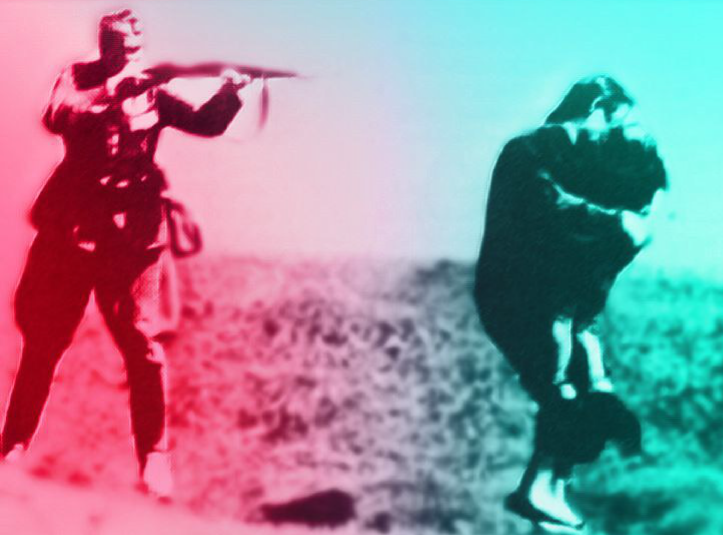
Again, during the mass shootings carried out by the Einsatzgruppen behind the German lines in Russia, many "ordinary" Wehrmacht soldiers turned out to watch the spectacle, until forbidden by superior officers. The perpetrators also talked of the killings when they went home on leave; Otto Frank, father of Ann, took his family into hiding after being told of the atrocities against Jews in the Baltic States by a Dutch SS man home from the Russian Front. As for concentration camps of all types, there were hundreds on German soil - according to Goldhagen, 606 in the state of Hessen alone. If ordinary Germans knew nothing of such places, then why did they fear being sent there? The extermination camps ("Vernichtungslager"), including Auschwitz, were situated in other countries where the local population knew of what was occurring behind the barbed wire fences. It seems strange that Polish partisan groups knew of what was happening in Auschwitz, and yet "ordinary" German soldiers said they knew nothing. Another disturbing detail that destroys this myth is the fact that escapees from the Berlin-Auschwitz transports recall that "ordinary" German railway workers taunted them about their eventual fate in the Auschwitz gas chambers. So much for the cosy myth.
It might be thought that I am taking the Patrick Moore view of the German people, past and present: "The only good Kraut is a dead Kraut". Or that I am simply endorsing the view expounded by Daniel Jonah Goldhagen in "Hitler's Willing Executioners". This was a book which raised some interesting questions, as Wikipedia says:
"The book challenges several common ideas about the Holocaust that Goldhagen believes to be myths. These "myths" include the idea that most Germans did not know about the Holocaust; that only the SS, and not average members of the Wehrmacht, participated in murdering Jews; and that genocidal antisemitism was a uniquely Nazi ideology without historical antecedents".
In that, Goldhagen does truth a service, but if everyone is guilty, then no-one is guilty. My own view is, hopefully, less simplistic than either the "We didn't know" or the Moore/Goldhagen view.
My view is this: Firstly, as has been said, the first victims of Nazism were Germans, the first people to fight against Nazism were Germans and the longest-serving resistance fighters against Nazism were Germans. Again, as has been said, there was another Germany. BUT - and I can't stress this enough - while there were millions of anti-Nazi Germans, there were still many more millions of Germans who supported Hitler, and endorsed violence against Jews (and many others). No totalitarian regime can survive by terror alone, without widespread popular support.To assert otherwise is an exercise in absurdity. Between these two poles of opinion - total innocence or guilt - there would have been many shades of willingness and opposition (if at all). Complex historical events cannot be reduced to simple-minded, dismissive, pseudo-explanations.
To conclude: I believe the "did they know?" controversy to be founded on a false premise - that had the German people known what was happening, they could, or would, have stopped the Holocaust. This "view" ignores the fact that the Third Reich was a highly efficient repressive state, which would have clamped down severely on any such dissent (and did). The "active arm" of the anti-Nazi opposition - socialists, communists and a few others - was crushed after Hitler's election triumph in 1933. After that, terror reigned. To use a more up-to-date example, if you know that your neighbour is a drug dealer, but, at the same time, you know that reporting him to the police will bring retaliation against you and/or your family, you have a powerful incentive to say nothing. And, as I hope I have shown, many Germans knew, and either approved or condoned the Holocaust anyway.
Cosy Myth: Some people in German uniform who didn't know what they were doing and were only obeying orders pointing guns at some people who we don't know.
Fact: Einsatzgruppen members, fanatical anti-Semites to a man, are about to murder a few of many innocent Eastern European Jews - men, women and children. Some estimates put the number of Jews murdered by these units as over a million.. They also murdered gypsies, Communists, Polish intellectuals and anyone considered to be an "enemy". All their victims perished in mass shootings; a small detail of one such killing spree is seen in the photograph.


Sunday, 12 January 2020

Harry, Meghan and the Racist Mindset

Well, they're going their own way, and who can blame them? The incorporation of Meghan Markle into our royals was never given much of a chance after their fairy tale wedding. From the outset, she was the target of a hostile tabloid press. Foremost among the hostile critics was our old pal, Nigel Farage, who, in Melbourne last August, lamented the fact that Harry was once:
"... a brave British officer who did his bit in Afghanistan... the most popular royal of a younger generation... then he met Meghan Markle, and it's fallen off a cliff."
It seemed as if Meghan could do nothing right, if our tabloids were to be believed. As Amna Saleem said in yesterday's Guardian: 
"She couldn’t even enjoy avocados without being framed as a drought- and murder-fuelling traitor, set on bringing down the monarchy. Harry, to his credit, has been by her side every step of the way, challenging traditions by demanding an end to the tabloids’ abuse of her, which sadly had little impact."    
Sad indeed, as we are set to lose our most progressive pair of royals since er...when? I didn't listen to Nigel Farage on LBC this morning - never do - but I bet he's smirking like a well-fed mongoose.
What has not been mentioned so far is the fact that Harry and Meghan's wedding came after the EU Referendum when hate crime against religious and ethnic minorities was increasing. This xenophobic tide, which Farage and others ride so skilfully, clearly influenced the tabloid press and made hostility to Meghan far worse than it would have been, say, ten years ago.
I don't believe that racism was the sole cause of the hostility. As said before, old fashioned upper-crust snobbery against a divorced, mixed race, American commoner would have played its part. Resurgent racism, though, was undeniably a major factor, and I think it needs looking at more closely.
So - what makes a racist, or, which is perhaps a better question, what is the racist mindset? It is difficult to answer this, as racism is an irrational attitude, best examined by social psychologists. However, I think that by providing insights from my own experience (and thus admittedly anecdotal) I can point to certain racist characteristics.
One such is the fact that racists rarely think clearly or logically. In the 1970s, I worked for Southport Parks Department. One of the foremen was a rabid racist. He'd served in the army in Palestine during the Jewish uprising in 1948 and was virulently anti-Semitic. For no apparent reason, he hated black people as well. One of his first questions to newcomers was: "Are n-----s human?". If you replied in the negative, that was fine; if you said "yes" you were no friend of his. When I asked him what he meant by human, he displayed his intellectual capacity by replying "Well...white". This overt racism would never be tolerated in any workplace nowadays (I hope), but at that time, his racism was well known to management - and tolerated.
One day, he was vehemently blaming coloured immigrants for lengthening queues in hospital A&E; the fact that there were hardly any black families in Southport did not occur to him. In fact, there were more people of colour working in the local hospital on any given day than were attending as patients. Pointing this out to him would have  had no effect. Racists, you see, start with their racism and look round for reasons to justify it. Even when their absurd anti-immigrant tropes are exposed as false, they simply look round for other reasons to be racist - rationalisations. 
Another was a man who'd lived in Yorkshire in what he described as "a good area". It seems that a black couple moved into one house and opened a brothel. "That's why I hate them!", he said - i.e. all black people. Very logical - I don't think. Both of these parks men were Conservative voters.
Racists often speak of their admiration for the late Enoch Powell whom, as we know, is deeply admired by Nigel Farage. Interestingly though, when you ask them "Well, what did Powell say that you agree with?", they are usually unable to give a coherent answer. Most appear to think he advocated compulsory repatriation, but he did not. In fact, the closer you question them about Powell, the vaguer they get. And this points to another racist feature - the incoherent understanding of Populist politicians like Farage and Powell and, it seems, politics in general. The classic example of this was the man interviewed on Channel 4 the day after the EU Referendum. This man had somehow acquired the belief - perhaps by osmosis? - that as of the next day, all Muslims were going to leave Britain. 
Sadly, racist views can be found among more intelligent whites also. Again, a narcissistic Southport racist I knew in the 70s, who prided himself on his IQ, among other things, held a senior position in a Southport hospital. Interestingly, he never expressed racist views in the hospital. His ethnic minority colleagues - doctors, nurses and others - never knew that he referred to them as "wogs" out of their hearing. Still less did he tell of how he had once actively considered joining the National Front, but he was at least more honest than the others when asked why he was a racist. No rationalisations from him. He confessed: "I don't know - I just don't like them!" ("them" being black people). Racists of this type were given encouragement by the rise of the National Front, and statements such as that made by Margaret Thatcher in 1978:
"People [in Britain] are rather afraid that this country might be swamped by people with a different culture".
Yes, it wasn't easy, opposing racism in the 1970s. I'd hoped that the intervening decades had put paid to such bigotry, but events are proving me wrong. I can only hope that those of us who believe in a tolerant, enlightened, multi-racial Britain can again successfully combat these prejudices, and perhaps restore a society in which Meghan, Harry, their son and all of us can live in peace.

Sunday, 5 January 2020

Assassinating Sulemani : A Pragmatist View

Regular readers of this blog, and those who glance at it from time to time, will know that I am not a great fan of the regime in Iran. I have highlighted the human rights violations of this state against its own people and  others for a number of years. I shall shed no tears over the liquidation of Qassem Soleimani, who was a key figure in the Iranian leadership and both a supporter and initiator of its repressive policies at home, and aggressive policies abroad. As The Guardian says:
"Suleimani, 62, oversaw the external operations of Iran’s elite Revolutionary Guards and was the architect of an expansion of Iranian influence across the Middle East in recent decades, controlling politicians and proxy militias in Iraq, Syria, Lebanon and Yemen among other places."
Nor do I deny the right of the USA to take action to defend its citizens anywhere in the world. The Pentagon claims that militants under his command had killed and wounded hundreds of US servicemen and were planning to kill more. Sulemani appears to have been involved in such activities since the invasion of Iraq in 2003 where, under the subsequent occupation, Shia militants under Iranian direction attacked both US and British troops with Iranian-supplied equipment. Sulemani's demise has been welcomed in parts of Syria and Iraq; Iranian exiles in the UK have been phoning talk radio programmes to express jubilation at his death.
So, do I share in this jubilation? Not really. To quote the same Guardian article:
" His killing triggered rejoicing in parts of Iraq and Syria, where he was implicated in tens of thousands of civilian deaths, but the general reaction in world capitals was one of apprehension."
Many people in the UK have criticised the killing, in particular Jeremy Corbyn, questioning the legality of the killing and the lack of notice to America's allies.  These issues will doubtless be discussed again and again in the coming weeks, but I would like to express my concern on pragmatic grounds.
Firstly, there is the small matter of ISIS. This group has taken a severe drubbing in recent months but is not totally defeated, and is trying to reorganise on the ground. Like it or not, Sulemani's fighters are a vital part of the struggle against ISIS and this is hardly the time to deprive them of their leader and thus to alienate them. It's rather like Churchill and Roosevelt assassinating Stalin in 1944, before the final German defeat. Unless they're stupid, ISIS will see an opportunity to strike a deal with the Shia militias.
Secondly, the timing of the attack was potentially dangerous to US and western expat workers in Iraq and Iran. The US government has advised its nationals to leave Iraq, but they would have become vulnerable to reprisal attack from the very moment of the assassination. Even if every US expat escapes safely, there will be plenty of other western nationals left behind to be attacked or held hostage. And, as we know, the Iranians already have a number of hostages in custody, including Nazanin Zaghari-Ratcliffe. Their position must now rank as downright perilous.
Next, President Trump is convinced that by threatening attacks upon Iran, he will deter any future hostile activity. As the BBC comments:
"President Trump, who authorised the attack on Soleimani on Friday - an option refused by both Presidents Bush and Obama as too risky - said on Saturday the US was ready to strike 52 sites "important to Iran & the Iranian culture"."
A more pragmatic approach would be to learn from three historical case examples of what happens when aerial bombing is used to try and subdue a civilian population: Britain 1940-41; Germany, 1942-45; North Viet-Nam, 1964-73. All these bombing offensives failed to break civilian morale, and only served to unite the native populations behind their leadership. There already seems to be some sign of this happening in Iran.
This "big stick" operation will not succeed in its main aim. Like it or not (and I don't), the Iranian regime has many supporters and Sulemani will be replaced, hydra-like, by someone perhaps even more militant, determined upon revenge. At the very least, I would expect the attacks on US installations in Iraq to continue and possibly increase.
While there are no good pragmatic results likely to flow from this situation, one positive result could be the beginning of the end for Populism worldwide. Complex political problems cannot be solved by simple actions. We have seen this with the trauma of Brexit, the comedy of the Mexican border wall, and I expect this crisis will be no different - apart from the fact that hundreds, perhaps thousands, of people will be killed and injured.

Saturday, 21 December 2019

The Rhymes and Routes Christmas Message, 2019

The Rhymes and Routes Christmas Message for 2019 comes from Ann Widdecombe, MEP and lead contralto for the Brexit Party Choir, seen in the photograph. The Blogmeister comments at the end of the message.

Ding-dong merrily on high! That's the wonderful old carol we are singing in the photo, and it sums up the way that I am feeling today! At last, after three years and after all the wrangling over Brexit, Boris Johnson has brought deliverance from a foreign yoke and set us free! I have longed for this day and I am absolutely brexcited about the wonderful future that stretches out before us. I am floating on clouds of ecstasy! This is a truly brexciting Christmas season!
As for Christmas itself, I think we should return to the Bible to see what it has to teach us about the present time. There is, of course, the wonderful Christmas story which tells of the birth of Our Lord, but, in the Old Testament, I think we can see the first Brexit - if under another name. I refer, of course to the Exodus of the Israelites from Egypt to the Promised Land. I thrill with excitement when I read the Book of Exodus; the Children of Israel must have felt, during their Exodus, that marvellous sense of deliverance as we in the Brexit Party are feeling now. Another wonderful parallel between the Exodus Story and the present time is that both escapes from slavery were led by a divinely inspired prophet. The Israelites were led by Moses; we have been inspired in our exodus by my esteemed colleague, Nigel Farage - a true leader of his people and - dare I say it? - a charismatic prophet like Moses.
Nigel is now being dismissed as a newly-irrelevant politician , but I believe him to be worthy of the highest honour. I hope to see him knighted at some time in the future. As to what happens to us Brexit Party MEPs and members now, I think we have a new role in returning to our old political parties and powering them on to our bright new future. But, this is still to be decided. I never liked travelling to the EU Parliament anyway - the rain in Europe isn't as nice as our bracing British rain. As far as I'm concerned, if Bonny Boris makes me an offer, I might well be returning to the Conservative fold.
Returning to the Bible and the Christmas Story, I would never be remotely prepared to suggest that Our Lord would have voted for Brexit. That would be brash, boorish and blasphemous. However, I do believe we can see a lesson for EU nationals living in Britain in the story of the Three Kings. who journeyed to Bethlehem to visit the infant Jesus. Read this extract from St Matthew's Gospel, Chapter 2, verses 10 - 12: 
"When they saw the star, they were overjoyed. 11On coming to the house, they saw the child with his mother Mary, and they bowed down and worshiped Him. Then they opened their treasures and presented Him with gifts of gold and of incense and of myrrh. 12And having been warned in a dream not to go back to Herod, they returned to their country by another route."
The last verse, I believe, is of great significance. The kings came to another country, fulfilled their purpose and then returned to their country. I hope all EU nationals living in the UK will learn from this example.
Christmas is a time for reconciliation and forgiveness, and I would like to say to all Remainers who read this: I forgive you! Even though you are all traitors and bolshies, we of the victorious Leave camp want to be reconciled to you, and stretch out our arms to you at Christmas. That goes for me, Bonny Boris, Nigel Farage and all who battled against your treachery. 
In conclusion, I wish all Rhymes and Routes readers a very Merry Christmas and a Happy New Year - even the traitorous Blogmeister and Rednev. By way of beginning the healing of divisions, I shall pray for you deluded renegades to come to your senses - if you have any. 
Season's Greetings!
Ann Widdecombe.
The Blogmeister comments:
I hate to sound like Ebenezer Scrooge, but the words "Christmas" and "Humbug" spring to mind here. Quite what Christians will make of Ms Widdecombe's interpretation of the Bible is beyond imagining. All I wll say is that if you, Ann, are floating on clouds of Ecstasy, then you have been taking the wrong tablets. The thought of you, Nigel Farage and Boris stretching out your arms to me makes me feel physically ill, and I'm sure many Remainers feel the same. Bah!

Tuesday, 17 December 2019

Dodgy New Tory MPs - Two Case Studies


In yesterday's Guardian, there was an illuminating article by Rajeev Syal and Rowena Mason: "Who are the Conservatives Most Controversial New M.P.s?". It is a very interesting piece, which I recommend to everyone who cares - here is the link. The article names five new Tory MPs (there could well be more) with what can only be described as dodgy credentials. These MPs do not like being scrutinised. One of them, Stuart Anderson MP, told his local paper that The Guardian had not told the whole truth about him. Mr Anderson and his colleagues should remember that the right-wing press are forever "exposing" the far Left pasts of Labour MPs. They deserve the same treatment, where appropriate, and in the case of the five MPs featured in the article, it is certainly appropriate. With all due respect to the Guardian article, I think that a closer look at two of these MPs, and a glance at another, could be productive. The two selected for closer scrutiny are Sally-Ann Hart, pictured above, MP for Hastings and Rye, and Brendan Clarke-Smith, MP for Bassetlaw.
As a manic Leave campaigner, Sally-Ann Hart, says The Guardian: 
"The new MP for the Tory marginal seat of Hastings shared a video with an image implying that Soros, who is Jewish, controls the EU. She also liked a Nazi slogan on Facebook.".
"Soros", is the Hungarian billionaire, George Soros, about whom I have written before, and is a hate figure for the far right. Our dear old pal, Nigel Farage, shares this antipathy and has accused Soros of being the mastermind behind the EU. Even Michael Gove has expressed concern over Mrs Hart's utterances, telling the Jewish Chronicle that they were "a cause for concern".
A further cause for concern is the fact that she has made some dubious comments about how disabled people with learning difficulties "don't understand about money". The Hastings paper, The Argus, comments:
"Martyn Ellacott, 63, head of the Phoenix Disability help group in London, said her comments were “disgraceful” and amounted to discrimination".
Mr Ellacott and others have said that Mrs Hart should stand down. Nice thought, Martin, but don't hold your breath.
Mr Clarke-Smith has roots in the teaching profession, as have I. According to NottinghamshireLive, he was once a head teacher in Transylvania, but I will resist the temptation to make vampire jokes. Instead, I shall quote The Independent: 
"Mr Clarke-Smith faced shouts of "shame on you" during an election hustings after he said food banks were a "political weapon" and it was "simply not true" that "people can't afford to buy food on a regular basis"
This would presumably put Clarke-Smith at odds with another of the MPs named in the Guardian article: Stuart Anderson, newly-elected MP for Wolverhampton South-West. Mr Anderson appears to have had a chequered career before he entered Parliament. As the article says:
"... five years ago, he received an illegal dividend from a security firm which went into administration owing £271,000 in tax".
Mr Anderson, a former soldier, understandably rejects this accusation, as well he might. What is of interest here is that he claims to have been bankrupted, lost his house and reduced to penury. Then, as the Express and Star says: 
"...he ended up using a food bank after losing “everything” when his first business went bust."
Now, there's an irony. Had Mr Clarke-Smith encountered him at that time, we can only guess at the comments he would have made - or what Mr Anderson might have said in reply.
These two examples, however much the Conservatives might seek to explain them away, are indicative of the new Conservative mind set. Tory pundits have told us that Boris will seek to re-establish "One Nation" Toryism. These new Tory MPs, and a number of others, would seem to heading in a different direction. As the twig is bent, so is the tree inclined. The rocky ride has begun.

Friday, 13 December 2019

The Election Result - Taking Stock

As you might expect, I am not pleased with the Election result. Many people who did not vote Tory feel the same and are asking themselves how it could have happened. After all, the record of the Conservatives in power, and their transparently dishonourable leader, would, under normal circumstances, have led to a resounding defeat for the Conservatives. But we don't live in normal times, and we are not living under normal circumstances. I think that the two main factors (not all) underlying the Tory victory are the continuing Brexit debacle and the ongoing crisis in the Labour Party.
What has appalled many of us is the fact that the Tories have done so well in traditional Labour constituencies. Boris and his merry men have made a special effort in appealing to the Leave voters in these areas, and it seems to have worked. People in such areas who voted Leave have felt that they were being ignored, and it did not help that there was no major concerted effort by all Remain parties to counter that feeling. Nor did it help that Labour refused to join the Remain camp, preferring to fudge the issue by promising a second referendum, which won't happen now.
The Labour Party, as many have noted, has not presented itself as an attractive alternative. The anti-Semitism crisis, whatever your view on that, has not helped Labour's image and has alienated many Jewish members and supporters. I have watched the response of Corbyn loyalists to this criticism and have noted their defensive reaction. The usual response has been the ultra-Left knee-jerk tactic of ad hominem attacks upon critics. The Chief Rabbi, who recently publicly criticised Jeremy Corbyn, immediately was demonised as a Tory and a Zionist propagandist. Jewish Labour MPs and others who have not followed the party line were vilified and abused to a horrendous degree. This witch hunt kind of activity might be acceptable in (now defunct) Respect or the SWP, but does not belong in grown-up politics. Abuse, ad hominem attacks and internal bickering are not a good advertisement for any democratic political party.
  
Unlike the opinion held by many of his critics, right and left, I believe Jeremy Corbyn to be a fundamentally decent man. I do not believe that he is a racist or an anti-Semite. He has a long and distinguished history as an opponent of Apartheid and the overtly fascist groups, such as the National Front. However, despite his anti-racist credentials, I believe him to have been a disaster as Labour Party leader. His insistence, for example, on making support for Palestine as part of the Labour Party programme was stupid and counter-productive. For one thing, it alienated many Jewish voters and, on the other hand, was totally irrelevant to British politics. His conspicuous lack of dynamism in dealing with Brexit was completely underwhelming and, I believe, cost Labour a lot of support. One Labour activist contacted me to say:
" In this working class area I delivered Labour pamphlets, but was amazed at the number of people who said 'I will never vote for him!' It was a sad comment as I have a very high opinion of Jeremy Corbyn."
Whether his partisans like it or not, a lot of people saw Corbyn as too far to the Left and too doctrinaire.
So, we who oppose them are now stuck with Boris and Brexit. All the Tory pundits in the media are glowing with triumphalism and speaking with confidence of what they intend to "achieve". Sad as I am about the election outcome, I am happily convinced that they are not in for an easy ride. The SNP triumph in Scotland will mean determined opposition to Johnson's plans for Brexit. Labour will be forced to exorcise its demons and become electable. On the dark side, the far right will become even more aggressive than they are now. I believe that we will see an increase in hate crime and fascist activity. I think we saw the beginnings of this on election night when a group of  hecklers - clearly of the far right - disrupted John McDonnell's acceptance speech after he retained his seat in Hayes and Harlington.
There are signs, also, that our ethnic minorities, even those who were born here, are feeling apprehensive, following Boris's victory. The Huffington Post interviewed a number of Muslims in the North West of the UK and they express considerable (and understandable) concern for the future. 20-year old Zainab Patel, a Blackburn university student, told The Huffington Post:
“As a Muslim, it makes me feel we are not welcome in this country any more...I feel so upset as everything feels so uncertain.."
She went on to say, quoted in the same article:
"People have gained confidence to vote that way and be more outspoken and vocal about their racism....With Boris Johnson’s leadership, it has given people in the UK confidence to air their racist views and their intolerance of people who are different to them.”
This "confidence" has been growing since the EU Referendum. It will not diminish under Boris, and the far right groups, including the rump of the Brexit Party, will not hesitate to exploit it.
The Tories will make some apparently generous contributions to education and the NHS, but will cut them back when they need to. They will maintain a nuclear deterrent, but will - I predict - achieve a rapprochement with President Putin. Immigration will become an even more emotive issue and Ireland an increasing cause for concern - to put it very mildly. We are in for a rocky ride. In a very short while, I think we shall see a sea change in the political scene. The groundswell of support for the Tories cannot survive their policies. Around Britain, people my age will be searching their cupboards for a badge from the Thatcher era: 
"Don't blame me, I voted Labour "..

Sunday, 1 December 2019

The London Bridge Attack: Again We Mourn

Once again, we are stunned at a senseless murder attack, motivated by extremist ideology. Once more, we are overwhelmed by the horror of the event and wondering how such an atrocity could happen yet again. The media have focussed on a number of relevant factors, all of which are being widely discussed, and will only be touched upon lightly here.
Last Friday's rampage on London Bridge has thrown up a number of diverse heroes, all of whom deserve the highest praise. Among the men who reportedly overpowered Usman Khan were a Polish national (Lukasz Koczocik), a Muslim dishwasher, a tour guide, a British Transport Police officer, one ex-offender, Marc Conway and a convicted murderer, James Ford.
According to The Guardian:
"Among those who pinned down the attacker was James Ford, 42, who is also thought to have tried to save the life of a woman who had been stabbed. Ford was jailed for life in 2004 for the murder of 21-year-old Amanda Champion."
The irony of two ex-offenders helping a police officer is mind-blowing, as is the idea of a murderer (Ford) restraining another (Khan). Professor David Wilson told The Guardian:
"He (Professor Wilson) said what had happened was a tale of two prisoners, with Ford an example of how people could change. “I know through my work that people do change and they change as a consequence of innovative but challenging regimes such as the one at HMP Grendon."
Apart from these disparate civilians, the reaction of the police was truly admirable. At the last London Bridge attack, about two years ago, it took an armed response unit seven minutes to arrive at the crime scene; this time it took five minutes. And, I am happy to say, nobody criticises the police for liquidating Khan, although some troll did put out a misleading tweet in Jeremy Corbyn's name.
The other issue is that of why Khan was released early from jail. Much is being said on this issue (rightly) and I do not want to comment directly. However, I can only compare Khan's early release to the early release of murderous mental health patients who kill again on release, which is a subject I have written about before. Khan had not actually killed anyone before being imprisoned, but he was planning to do it on a big scale. Our old pal, Nigel Farage, has said that anyone who commits a terrorist offence should never be released. Nigel is seeking to ride on a wave of public anger and will undoubtedly say that he is simply speaking for "ordinary people". Perhaps Professor David Wilson and Nigel Farage should hold a TV debate on this subject - perhaps we should all be talking about it.
I can only point out that the much-vaunted deradicalization programmes in prison do not seem to be working as well as they are supposed to. People are not automatons that can be re-programmed like robots or computers - unless they want to change, they won't change. Usman Khan seems to have  voluntarily undertaken such courses in prison. He must have gone through them like atheists who listen politely in church, yet remain atheists. For Khan, and imprisoned terrorists like him, these deradicalization courses must seem a good way to work your ticket.
Returning to the analogy of released mental health patients, we see in Khan's early release an error of judgement of the same gravity as those made by the mental health authorities with Nicola Edgington and Kordian Filmanowicz. This is a fiendishly difficult matter to resolve: how do we decide when it is safe for violent prisoners to be released? And how can we prevent relapses - whether into extremism or mental health driven violence?
In conclusion, I would like to say that our hearts should go out to the victims of Khan's attack - in particular to the families of Saskia Jones (23) and Jack Merritt (25) - two young lives cruelly snuffed out; both bright, hopeful and heading for good careers - people the world needs. At least we can say goodnight to Usman Khan, who was no asset to humanity. Unfortunately, there seems to be nothing to stop others following in his footsteps.

Tuesday, 26 November 2019

Vladimir Putin - a Complex Case?

Rednev, my esteemed friend and colleague, occasionally pokes fun at me about my "hate figures": OFSTED, Iran, George Galloway, etc. For some reason, he never includes Vladimir Putin, and I'm starting to suspect that he is falling under Russian influence. I will only learn the truth when the government releases details of the dossier on Russian interference in our political affairs - the one that the government denies suppressing. Hilary Clinton has described the suppression "shameful", but then, she has experienced the effects of Russian meddling, as a US Presidential candidate.
Ridiculous, of course. Rednev is no friend of Putin, any more than I am - the case of vodka in my garden shed has been there for years. The report, due to be released after the election on December 12, promises to be disturbing. For people of my generation, who grew up in the Cold War years, it is incredible how the Russian influence pendulum has swung from one extreme to another. In the 60s and 70s, it was the Labour Party that was being branded as pro-Communist stooges in the pay of Moscow. Now, we read in The Guardian:

"Allegations that Moscow money has flowed into the Conservative party via emigres living in the UK making high-profile donations, were also heard ... although the party has consistently denied receiving money improperly.
In 2014, Lubov Chernukhin – the wife of the former Russian deputy finance minister – paid £160,000 to play tennis with Johnson and David Cameron. The match was the star lot at a Conservative summer party auction. Another guest at the 2013 fundraiser was Vasily Shestakov, Vladimir Putin’s judo partner".

There have also been credible reports that the Brexit Party is in receipt of Russian cash. More details of this can be found HERE.
It would appear that Russian influence extends only to the political Right, but this would be a mistake. Jeremy Corbyn was accused of "a cross-eyed" response to the Skripal poisoning. Andrew Rawnsley said, again in The Guardian:

"In his first parliamentary performance, and in subsequent interventions, Mr Corbyn refused to blame the Putin regime while raising a spray of questions that undermine the case for coordinated western action. Was it really the Kremlin? Can the government prove that?"

George Galloway expressed much the same opinion at the time, as did others of his ilk. His "ilk", however, includes the brother of one of Galloway's many protagonists, Christopher Hitchens: Peter Hitchens, who is hardly a leftist militant.
Russian influence, it seems, is widespread and found across the political spectrum. This is a matter of concern, but we should remember that we British also have a name for interfering in other nations' political affairs, both historically and perhaps even now.
Perhaps we should focus upon why President Putin and his government feel the need to exert influence in other countries and to look at the character of Vladimir Putin himself.
During the Cold War years, the right-wing press were in a perpetual stew about the evils of Communism and the USSR. It was conveniently forgotten that during the 19th century, British politicians regarded Russia as "The Russian Bear" that kept trying to take over in India. It was portrayed (rightly, to an extent) as a backward serf-owning land-hungry "evil empire" - to coin a phrase. How times changed! From 1914 to 1917, Russia was our gallant ally - then times changed again. Josef Stalin became another Russian supremo, dressed up in ideological clothes - a "Red Tsar" and a hate figure for the West in the 1920s and 30s. All that changed of course; Stalin became "Uncle Joe", our gallant ally in WW2, but only after Hitler invaded the USSR in 1941. Things changed again in 1945, when Stalin became our enemy, after he acquired new nations for the Russian sphere of influence, and appeared, we were told, to be planning to spread even further westwards.
 It was left to a Hungarian writer, Tibor Szamuely, to point out that the basic status quo in Russia during the Stalinist period was fundamentally the same as it was in the Tsarist era. This absolutist legacy, Szamuely argued, was "The Russian Tradition" - the title of his book. He had a point, and we must acknowledge that parliamentary democracy, such as it is now in Russia, is something very new. And, if Szamuely was right, Putin is a mutated form of a Tsar or Supreme Leader, with his own, modern version of Russian expansionism.
But I think we can discern something else, if we look a little deeper into Putin's background. As everyone knows, Putin was a senior KGB officer. He resigned as a Lieutenant-Colonel on 20 August, 1991.
What nobody says is that while he was indeed a KGB officer, he was not a particularly good one. He worked at first in counter-intelligence after joining in 1975. His lacklustre career then "blossomed" in 1985, when he was sent to Dresden for five years, posing as a translator. This would never do as a biography for a Bond villain. For that, he would have needed to be a KGB General, at least. If anything, his foreign policy is reminiscent of a man with an inferiority complex. He seethed with resentment after the drubbing Russian troops took in the First Chechen War (1994-96) and wasted no time in launching a war of revenge in 1999.
I don't know what will emerge when the report is released, post-General Election, but I wouldn't be surprised if clear evidence of Russian influence is readily uncovered. And this points to a real problem for President Putin: the fact that his secret service operatives, like he was, are not particularly successful or effective. The Skripal poisoning and the poisoning of Alexander Litvinenko were hardly models of efficiency. In both cases, the culprits were quickly identified and displayed gross incompetence in their handling of poison and radioactive material. The FSB, successor organisation to the KGB, is of the same standard as that achieved by Vladimir Putin.
No wonder he looks like a man with a complex.
Vladimir in his KGB days - a rising star that didn't go far.

Saturday, 16 November 2019

Nigel Farage: Following Robespierre?

Maximilien Robespierre (1758 - 94), pictured above, was one of the key figures of the French Revolution. He is known to history as the monster who led the Jacobin revolutionaries to power and instituted "The Terror", which led to thousands of political opponents ( and many innocent people) being put to death, most famously, but not exclusively, by the guillotine.
This is undeniable, but there is an aspect of his character that is of interest here: despite his ideologically-driven murderousness, he was a firm opponent of political corruption. In fact, he was known as "the sea-green incorruptible" - and woe betide anyone who tried offering him a bribe.
It comes as a surprise to find that our old friend, Nigel Farage, seems to be following in Robespierre's footsteps. Two days ago, Nigel announced that unnamed senior Conservative Party officials had offered jobs and peerages to Brexit Party electoral candidates to try to get them to stand down. The BBC stated: 
"Mr Farage also said his candidates received "thousands of phone calls and emails" trying to get them to withdraw ahead of next month's election".
Interestingly enough, Mr Farage didn't make this claim until after election nominations had closed, but let that pass for now.
To my surprise, no-one in the media asked any of what I regarded as highly pertinent questions. Why, I wondered, had this issue not been raised before? Mr Farage is the Brexit Party leader, of course, and such allegations would have been reported to him. However, I found it strange that none of these targeted Brexit Party candidates had gone public straight away about these inducements, or even leaked details of them to the press. Somebody, surely, would have mentioned something - or so I thought.
Beside this, why did Nigel wait for nominations to close before he released details of these bribes? Should he not have acted as soon as these nefarious Tory attempts at corruption were made known to him?
To be fair, Mr Farage did threaten, after two Brexit Party candidates stood down this last week, to report the matter of bribery to the authorities - but didn't. Instead, it has been left for a Labour Peer to contact the police. As the Evening Standard says:
"Lord Falconer has written to the Metropolitan Police Commissioner and Director of Public Prosecutions and said the "exceptionally serious allegations" should be investigated as a matter of urgency. He said they must be looked at by police in order to maintain public confidence in the integrity of the election."
That is very well said, and if Tory grandees have been illegally resorting to bribery, then it is a matter for the police. However, such an investigation may lead to a wider inquiry into the role of patronage in UK politics, and that will not go down well in influential quarters.
Lastly, it seems to me that this whole matter has been of great benefit to the Brexit Party. They have been able to present themselves as injured innocents and victims of the "Establishment". It has provided the Brexit menagerie with a highly useful diversion from their links with far right and anti-Semitic characters, which Hope not Hate has detailed at length. In fact, the far Right has loudly trumpeted their endorsement of the Brexiteers. As Hope not Hate says:
"The extreme anti-Muslim street movement Britain First (BF) has given Farage’s party its dubious endorsement. In a statement uncovered by Scram News, the group claimed on Monday that “The Brexit Party are the only ones fighting for a proper Brexit, we’re right behind them”. 
And then of course, there is the small matter of alleged Brexit Party financial links with Vladimir Putin, which I wrote about on September 22nd.  Again, the "jobs and peerages" scandal has provided the Brexit Party with a welcome diversion. Small wonder, then, that Nigel Farage was smiling so effusively when he released the news of alleged Tory bribery.

Wednesday, 6 November 2019

Heroes with feet of clay

There is a lot of frustration with politics at present and this is often expressed on social media by quotes by or about figures from history,  Guy Fawkes and Oliver Cromwell in particular at the present. I would argue that this can often be unhelpful or, worse, downright deceptive.

Guy Fawkes: it's something of a joke that he was the last man to enter Parliament with honest intentions. However I'd beg to differ if anyone genuinely considers that Fawkes' actions constitute honesty. New Scientist published an article on 5 November 2003 explaining how the Gunpowder Plot would have devastated London. The study concluded that, as well as destroying Parliament and killing everyone inside, the explosion would also have:
  • Destroyed Westminster Abbey.
  • Razed everything to the ground within a radius of about 40 metres.
  • Within 110 metres, at least partially destroyed buildings.
  • As far as 900 metres away, blown out some windows.
I have projected this onto a map of Liverpool, the city of my birth, placing the hypothetical explosion at the iconic Bombed Out Church. The two circles represent the 110 and the 900 metre points. The damage would have reached St George's Hall, the docks, and would have extended way beyond both cathedrals and the Philharmonic Hall. Bearing in mind that buildings were considerably more flimsy in 1605, the damage would be much greater than now. Fires would have inevitably followed and the Great Fire of London may have happened 61 years early. It's safe to assume that in the closely packed houses, perhaps tens of thousands of ordinary Londoners would have perished. It would have been one of the worst mass murders in English history, and because Fawkes was a gunpowder expert, we cannot excuse him on the grounds that it was overkill by an amateur - quite simply it would have been a deliberate and utterly callous act of terrorism.
[Click on the map for a bigger image.]
Oliver Cromwell: his famous speech dissolving the Long Parliament on 20 April 1653 has recently been extensively reproduced on social media:
"It is high time for me to put an end to your sitting in this place, which you have dishonoured by your contempt of all virtue, and defiled by your practice of every vice; ye are a factious crew, and enemies to all good government; ye are a pack of mercenary wretches, and would like Esau sell your country for a mess of pottage, and like Judas betray your God for a few pieces of money.
"Is there a single virtue now remaining amongst you? Is there one vice you do not possess? Ye have no more religion than my horse; gold is your God; which of you have not barter’d your conscience for bribes? Is there a man amongst you that has the least care for the good of the Commonwealth?
"Ye sordid prostitutes have you not defil’d this sacred place, and turn’d the Lord’s temple into a den of thieves, by your immoral principles and wicked practices? Ye are grown intolerably odious to the whole nation; you were deputed here by the people to get grievances redress’d, are yourselves gone! So! Take away that shining bauble there, and lock up the doors. In the name of God, go!"
 An impressive speech, certainly, but should we be impressed by the man? I would argue that he was a deeply flawed leader whose faults seriously tarnish (and in my opinion outweigh) his positive achievements.
  • After dissolving Parliament, Cromwell ruled England as a dictator, instituting the only military regime this country has ever known.
  • He ruthlessly suppressed popular movements among his own followers such as the Levellers and the Diggers because they challenged the property rights of the land-owning class from which he was descended
  • It is not known exactly how many people were massacred by his troops in Ireland, but it may have been as much as a fifth of the population. The Irish historian Micheál Ó Siochrú describes the slaughter at Drogheda and Wexford in 1649 as ranking among the greatest atrocities in Anglo-Irish history, and considers Cromwell to have committed of war crimes, religious persecution and ethnic cleansing.
  • Less important, but still significant, is the fact that as Lord Protector he was paid £100,000 per year, equivalent to more than £22 million today. In contrast, the UK prime minister is paid just over £151,000, which in real terms is about 0.7% of Cromwell's remuneration. Snout in the trough on a massive scale.
  • Cromwell did not believe in democracy, despite the mistaken view held by some on the Left and the dialogue written for his character in the 1970 film Cromwell.
Quoting historical figures out of context can be deceptive and in an era of political turbulence, as now, can cause people to form inaccurate judgements. History isn't a collection of soundbites to be deployed as and when needed. As a qualified history teacher, I feel strongly that we can learn a lot from the past - however, politicians often cherry-pick bits from history to suit their short-term political agenda, but they're not alone - on social media, some ordinary people do just the same.

A failure to learn from the past is a lost opportunity to avoid endlessly repeating its mistakes. Sadly, that is what happens all too often.

Sunday, 20 October 2019

Marching for Sanity - Yesterday's People's March

Photo by Mila Caval

No-one has ever told me that I was one in a million, but yesterday, I was just that. I took part in the People's March for a second referendum on Brexit. The right-wing press have been spitefully critical of the march, but even they have had to admit that the number of marchers reached a million - which is quite something of itself. People travelled to attend the march from all over Britain. One such person was Ali Lothian (60) from Dundee, who told the BBC:
 "It's a big commitment - it's a whole weekend. But I regretted not coming last time." 
I didn't go to the last one either, but, as Brexit appears to be drawing near, I felt that I had a duty to be there this time. I had no idea that the event would be so well attended. When I emerged from the Tube at Green Park station, I was astounded at the numbers.
Anyone who has attended a large demonstration knows how easy it is to lose contact with people. I had arranged to join up with friends, but somehow that didn't happen, so I joined in with a hotchpotch of interested groups. Several people told me that this march was less light-hearted than the previous one, which reflects the seriousness of the situation we now face. Katie Wright of the BBC says:
"In March a carnival vibe accompanied the slow walk from Park Lane to Parliament Square, but university student Ben Stocks said the atmosphere this time was "more sombre". Another member of the crowd, Simon Gosden, 63, agreed, saying: "There's more of an air of tension. We know we're getting down to the nitty gritty - it's all or nothing."
This does not mean that we all marched with a frown. There were moments that made me smile, at least. There was a young lady who brought her dog:
There were people who had made huge sacrifices to attend the demonstration:

Then again, there were people who dressed up to mock dear old Boris, as can be seen in this photo taken by Mila Caval:

The placards carried by marchers were pithy and accurate in their slogans.

I have to own up: I didn't make it to Parliament Square. I wasn't there to listen to the variety of speakers, including John MacDonnell and Sandy Toksvig. Nor did I hear the announcement that Boris had been thwarted in his attempt to enforce Brexit. I found it necessary to seek refreshment in the Whitehall branch of Wetherspoons, where I finally managed to meet my friends. I enjoyed the irony of this, as the pub's owner, Tim Wetherspoon, is a rabid Leave campaigner. Cheers, Tim!
Cynics, and sometimes demonstrators themselves, often ask "What good do demonstrations do?". In the case of cynics, there is little point explaining anything, but for myself, I felt that the march was more than worthwhile. I hope that it demonstrates to everyone, here and abroad, that we Brits are not just a bunch of lemmings headed for the cliff edge and, should the Brexit disaster happen, at least we can say that we did our best to stop it. It also united Remainers of all political persuasions and none. The whole spectrum of Remain opinion marched together yesterday, from Socialist to Liberal Democrat to Conservatives. The only jarring note was the hounding of MPs at the House of Commons. As has rightly been said - that kind of behaviour is unnecessary and counter-productive. If we can't win by peaceful pressure, we can't win anything at all by threats of violence.
Chilling in The Lord Moon of the Mall, I noticed something remarkable. There were many people from the march, as expected, but there was also a contingent of people in camouflage trousers, sporting military style berets. One even wore a t-shirt with the logo: "Northern Ireland Veteran." These were people who had come to counter-demonstrate, yet, within the confines of the pub, both sides ignored each other. That changed outside, where these aging ex-servicemen began singing songs in praise of Boris. To my surprise, I found myself feeling sorry for them. None looked as if their post-service lives had been rewarding, which is typical of many ex-military people of all nations and all ages. People like this look for scapegoats. Many German WW1 veterans blamed the Jews for their defeat in 1918; these men blame the EU for their woes. There were very few of them and, like I said, they looked somewhat pitiful. I can only hope that Brexit will not reduce us all to a similar impoverished state.
Irrational as the beliefs of these men were, they are no more muddled in their thinking than all the Brexit supporters I have ever met or listened to. I have yet to hear an opinion in favour of Leave that isn't either based on emotion, distorted facts or downright lies. These counter-demonstrators were probably motivated by xenophobia - but aren't all Brexit supporters to some extent? For this reason, I say that yesterday's march wasn't just about Brexit - it was a march for sanity.
As I walked to Leicester Square tube to catch my train home, I felt glad to have taken part in what must have been one of the biggest and best attended demonstrations in our history. I hope we did some good. We did, didn't we?